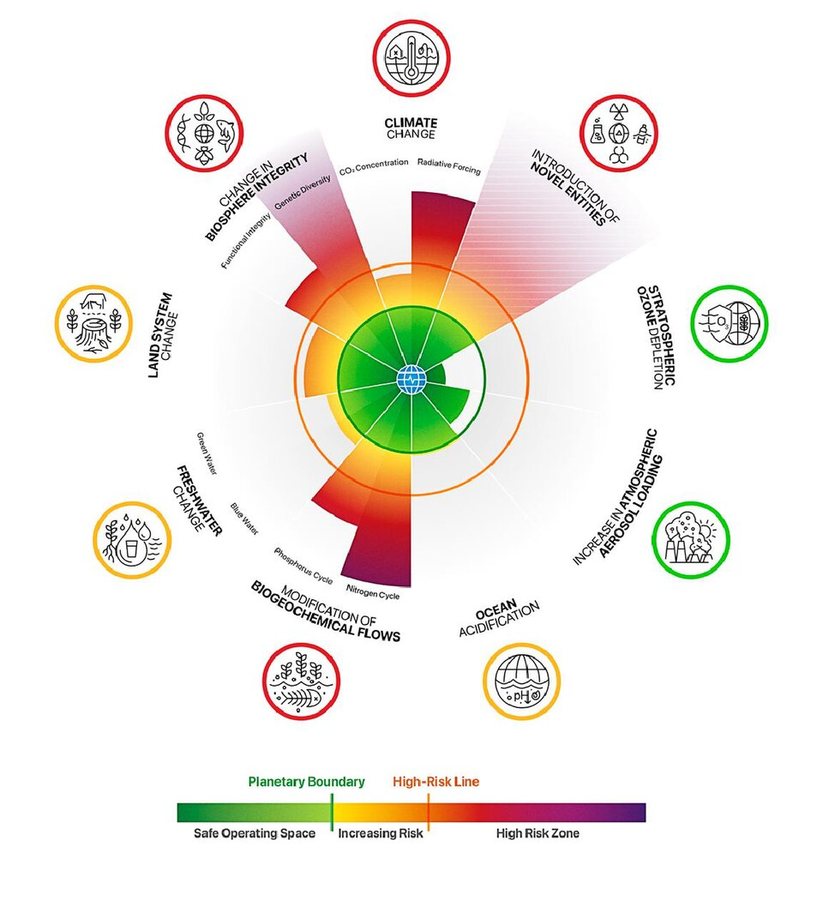
Seven of the nine planetary boundaries that help determine whether life can flourish on Earth are being breached at their highest levels ever recorded, according to the latest annual planetary health check. The assessment, a process established in 2009, warns that the planet's life support systems have deteriorated to their worst state since monitoring began, driven by ongoing pollution and habitat destruction.
The planetary boundaries framework identifies nine critical Earth system processes — including climate change, biodiversity loss, land-system change, freshwater use, and the introduction of novel entities such as plastics and chemicals — that together define a safe operating space for humanity. When a boundary is transgressed, the risk of abrupt and irreversible environmental change increases. According to the new report, seven of these nine boundaries are now being exceeded, and the level of transgression is higher than at any previous point in the assessment's history.
Scientists behind the update describe the findings as grim but essential for understanding the scale of the challenge. The report indicates that the cumulative effects of pollution and habitat destruction are pushing key indicators of Earth's health outside the safe operating space, raising the prospect of a climate disaster if current trends continue. The planetary health check is designed to provide a regular, science-based snapshot of the planet's condition, and this year's results show a continued downward trajectory.
The framework was first proposed in 2009 by a group of international researchers led by Johan Rockström, then at the Stockholm Resilience Centre, and has since become a widely cited reference for policymakers and scientists. It defines boundaries for processes such as climate change, biosphere integrity, biogeochemical flows, ocean acidification, stratospheric ozone depletion, atmospheric aerosol loading, freshwater change, land-system change, and novel entities. Breaching a boundary does not mean an immediate catastrophe, but it signals that the risk of destabilizing the Earth system is growing.
This year's update places particular emphasis on the role of pollution and habitat destruction in driving the deterioration. The loss of biodiversity and the degradation of ecosystems reduce the planet's capacity to absorb shocks and maintain the conditions that have allowed human civilizations to thrive. The report's authors stress that the findings are not a prediction of inevitable doom but a call for urgent action to reduce pressures on the Earth system.
The planetary health check is published annually and is intended to track progress — or the lack of it — in keeping human activities within safe limits. With seven boundaries now breached at record levels, the report makes clear that the window for corrective action is narrowing. The scientists warn that without rapid and sustained reductions in pollution and habitat destruction, the planet's life support systems will continue to degrade, with consequences for food security, water availability, and human health.
The findings add to a growing body of research showing that the cumulative impacts of human activity are pushing the Earth into a state that has no precedent in recent geological history. The report's authors urge policymakers to treat the planetary boundaries as non-negotiable limits and to integrate them into economic and environmental planning. They note that the framework is not about returning to a pre-industrial past but about maintaining the conditions that allow life — including human life — to flourish.
As the annual update makes clear, the trajectory is not improving. Seven of nine boundaries are now in breach, and the level of transgression is the highest ever recorded. The scientists behind the assessment say the results should serve as a stark reminder that the planet's health is deteriorating and that the time to act is now.