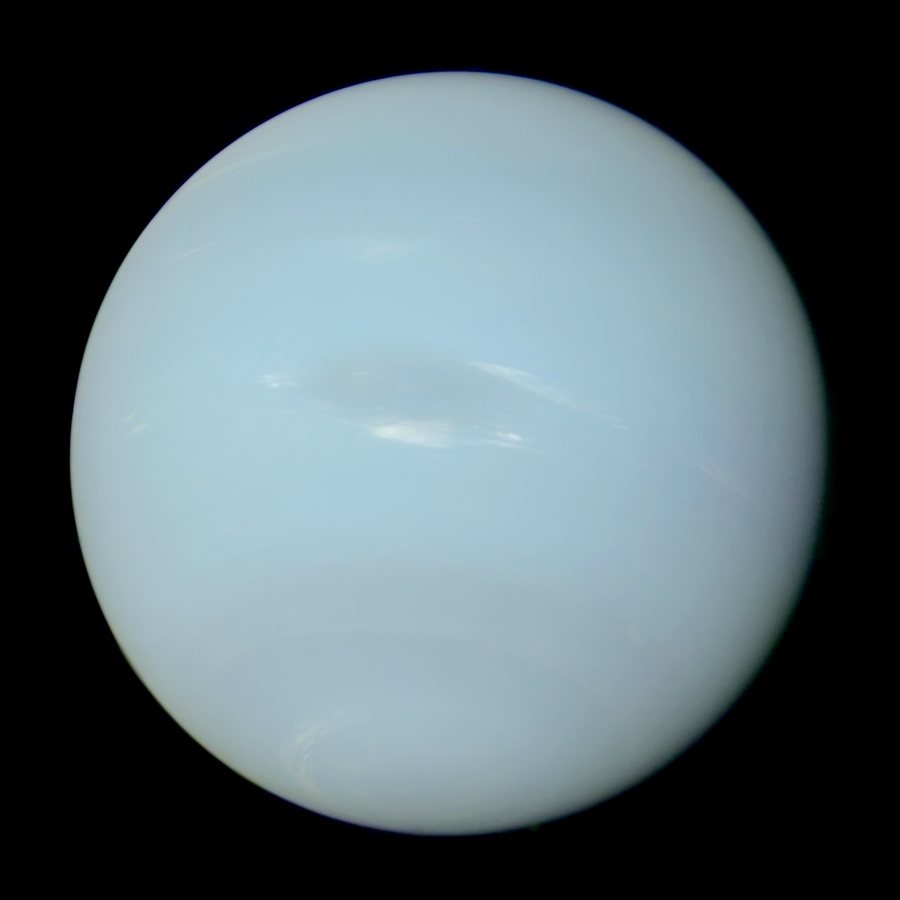
Uranus and Neptune are so alike in size, mass and atmosphere that they are often described as twin planets. A new study suggests they may not have begun in the same place. Researchers report that the two ice giants likely drew their raw materials from different regions of the disk of gas and dust that surrounded the young Sun, pointing to two distinct evolutionary paths.
The study, published last week in Astronomy & Astrophysics, was led by Tom Briand of the Laboratoire d'Astrophysique de Marseille and Olivier Mousis of the Southwest Research Institute. Its central finding concerns chemistry. The deep atmosphere of Neptune appears to be considerably richer in oxygen than that of Uranus. "Uranus and Neptune may look like twins today, but their chemistry tells us they are more like cousins with very different histories," Mousis said. Briand added that the compositions of their atmospheres could be linked to different zones of the protoplanetary disk where the planets formed, which would make their similarities a notable coincidence.
Because the thick clouds that cover both worlds block direct access to their deep atmospheres, the authors used a chemical tracer: carbon monoxide. Its presence in the upper troposphere, detected in part through recent observations of Uranus made with the Atacama Large Millimeter/submillimeter Array, preserves information about chemistry in deeper layers. "Studying carbon monoxide is particularly useful given its abundance in the upper troposphere of many planets," Mousis explained. "Using these data, we can model the chemical evolution of the protoplanetary disk and the origins of its materials."
Using this approach, the team estimated the carbon-to-oxygen (C/O) ratio. For Uranus, the values fall between 0.06 and 0.52. For Neptune, they range from 0.02 to 0.12. These are indirect estimates rather than measurements of conditions inside the planets. To interpret the difference, the researchers simulated the disk of gas and dust around the young Sun. The C/O ratio of Uranus can be reconciled with what would be expected at its present distance from the Sun. Neptune's ratio, however, appears to require material that formed farther inward in the disk, near the water condensation line. "It is difficult to reconcile Neptune's chemical composition with the idea that it formed where we see it today, drawing from the same reservoir of cosmic materials as Uranus," Mousis said. Instead, the models suggest that Neptune's building blocks traveled a long way before the planet was able to accrete them.
The hypothesis is that Neptune's building blocks followed a history of outward migration. The authors stress, however, that this is not yet conclusive. The C/O ranges of the two planets partly overlap, and the estimates depend largely on how effectively gases are vertically mixed in the atmosphere. The findings are therefore best read as a clue to how the outer Solar System assembled, rather than a settled answer.