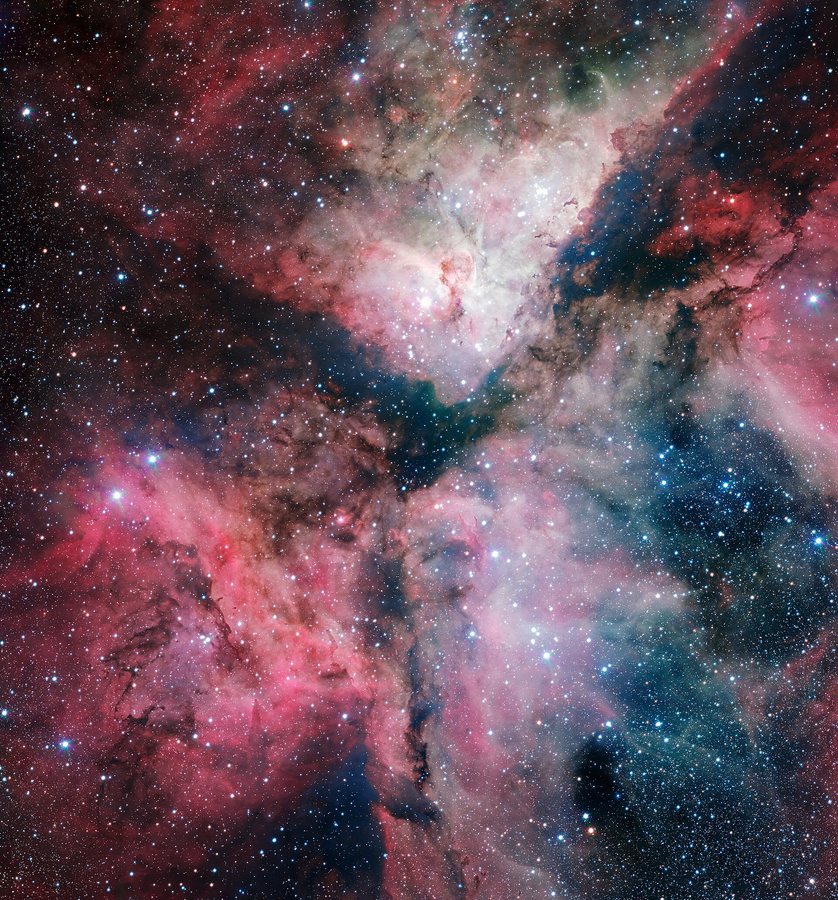
The Sloan Digital Sky Survey V (SDSS-V) has released a public preview of the Local Volume Mapper (LVM), a spectroscopic survey that maps ionized gas and the interstellar medium of the Milky Way and nearby galaxies. The data release, part of the survey's Data Release 20 (DR20) made available on August 6, gives astronomers and the public an interactive look at how massive stars are born in cold molecular clouds and how they return energy to their surroundings through ultraviolet radiation, stellar winds, and supernova explosions — a process known as stellar feedback.
Understanding the physics that regulates these feedback cycles is one of the major challenges in astrophysics, as astronomical instruments typically must choose between a broad view of a nebula or a detailed chemical analysis of its gas. The LVM aims to bridge that gap. Operating since 2023 at the Las Campanas Observatory in Chile, the instrument consists of an array of four telescopes with 16-centimeter primary mirrors, offering a field of view wide enough to capture the entire Moon in a single exposure. Instead of taking standard two-dimensional photographs, the array uses an ultra-dense grid of optical fibers to break down light at every point in the field into more than ten thousand spectra simultaneously, producing hyperspectral cubes with two spatial dimensions and one spectral dimension.
By analyzing specific emission lines such as ionized sulfur, hydrogen-alpha, and doubly ionized oxygen, researchers can map the temperature, density, chemical abundance, and motion of interstellar gas along the Milky Way with high precision. The DR20 release includes a preview of 300,000 spectra across six target regions, including the Trifid, Rosetta, Orion, and Helix nebulae, as well as two nearby dwarf galaxies. This represents about one percent of the more than 55 million spectra expected from the full LVM survey. The data are accompanied by open-source code and analysis pipelines to ensure reproducibility and immediate reuse.
Early studies already demonstrate the power of this spatial-spectral mapping. In the Trifid Nebula, density varies significantly due to the interaction between stellar radiation and surrounding molecular gas, yet temperature remains remarkably uniform across the two-dimensional view, making it an ideal laboratory for studying the chemical composition of star-forming regions, according to Natascha Sattler, a doctoral student at the University of Heidelberg and lead author of the study on that nebula. In the Rosetta Nebula, detailed gas mapping allows researchers to trace how energy from massive stars reshapes the cloud and influences the evolution of star clusters forming within it, said Mónica Villa-Durango, a doctoral student at the National Autonomous University of Mexico (UNAM) and lead author of that study.
Kathryn Kreckel of the University of Heidelberg, an LVM project researcher, said the observations highlight the extraordinary breadth and depth of the survey, revealing complex ecosystems of gas and stars with extreme precision. With millions of spectra still to be collected, she noted, the scientific opportunities are just beginning to be explored. Sebastián Sánchez of UNAM, the LVM program lead and lead author of the study on the Helix Nebula, said the time has come to exploit this enormous distributed dataset, exploring the interstellar medium across a range of physical scales never covered before — from resolved nebulae to entire galaxies — and creating synergies with other surveys and multi-wavelength explorations.
Together, these studies show how complex star-forming regions in distant galaxies are easily misunderstood when their internal physics cannot be directly resolved. To make the data accessible to professionals and the public alike, the team developed LVMvis, an interactive browser that shows which portions of the sky have been observed and allows immediate exploration of the measured data without requiring specialized skills. The stellar birth cycle, from interstellar and intergalactic material and back again, remains one of the most important research questions in modern astrophysics, and the LVM dataset is designed to help test theoretical models against observations.