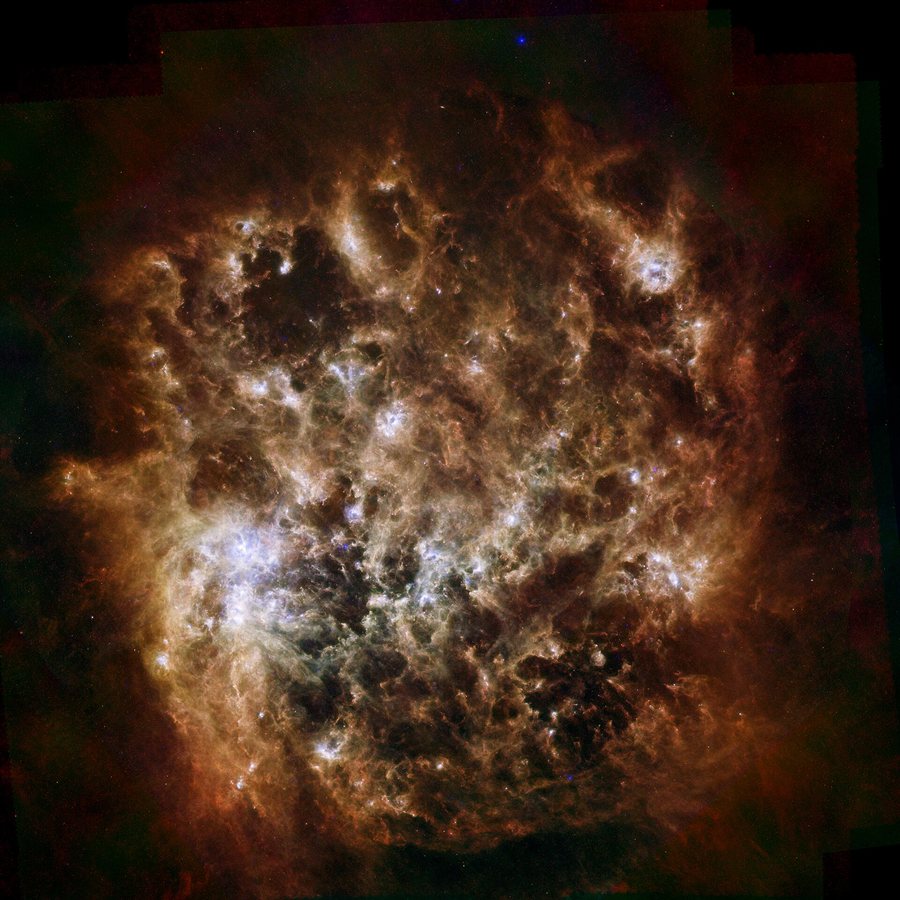
NASA's James Webb Space Telescope has produced a single image that captures stars at several stages of their formation in N159, a star-forming region about 161,000 light-years from Earth. Some newborn stars have already emerged from the clouds that gave birth to them, while others remain embedded in the gas and dust from which they are taking shape.
The image covers a patch of N159 roughly 230 light-years wide, within one of the youngest and most active star-forming complexes in the Large Magellanic Cloud. The details were revealed by NIRCam, the near-infrared camera aboard Webb, which can penetrate, at least in part, the dust clouds that hide the youngest stars.
The colors in the image do not correspond to what the eye would see. They were assigned to different wavelengths of infrared radiation to make gas and structures easier to distinguish. Blue regions show ionized hydrogen, atoms that have lost an electron to the intense ultraviolet radiation of hot, massive stars, which is why astronomers classify N159 as an H II region, an environment of intense star formation. Orange hues reveal polycyclic aromatic hydrocarbons, carbon and hydrogen molecules found in interstellar material. Dark red filaments of cold molecular hydrogen cut across the scene, particularly in the central area. The densest parts of these filaments shelter some of the youngest stars from intense radiation and stellar winds, while gravity continues to pull matter toward the objects forming there.
Among the structures captured is the Papillon Nebula, the compact, bright concentration of ionized hydrogen visible on the left. It is probably linked to the birth of massive stars, and its structure was first resolved by the Hubble Space Telescope in 1999.
N159 also offers a chance to study star birth under chemical conditions different from those of the Milky Way. The Large Magellanic Cloud has fewer elements heavier than hydrogen and helium, which astronomers call metals. That makes the region useful for understanding how stars formed in the early universe, when such elements were less abundant.
The observations are part of a scientific program studying the stellar populations in the region. Analyzing Webb data taken through ten near-infrared filters, an international team led by Nolan Habel of NASA's Jet Propulsion Laboratory identified more than 300,000 point sources, including extremely faint stars with masses below one-tenth that of the Sun. The analysis distinguished more evolved stars from very young ones, including populations younger than half a million years, and flagged possible stars still forming inside the gas and dust. Some show an excess of infrared emission, a sign of circumstellar material enveloping the youngest objects.
The distribution of these populations points to the region's history. More evolved stellar populations sit in the eastern part of N159, while the western side hosts a higher concentration of very young objects still associated with gas and dust filaments. This pattern supports the hypothesis of sequential star formation, in which stars did not form everywhere in the cloud at once but in different areas at successive times. The process is still under way, with some stars already lighting up the surrounding space and others being born within the gas and dust.