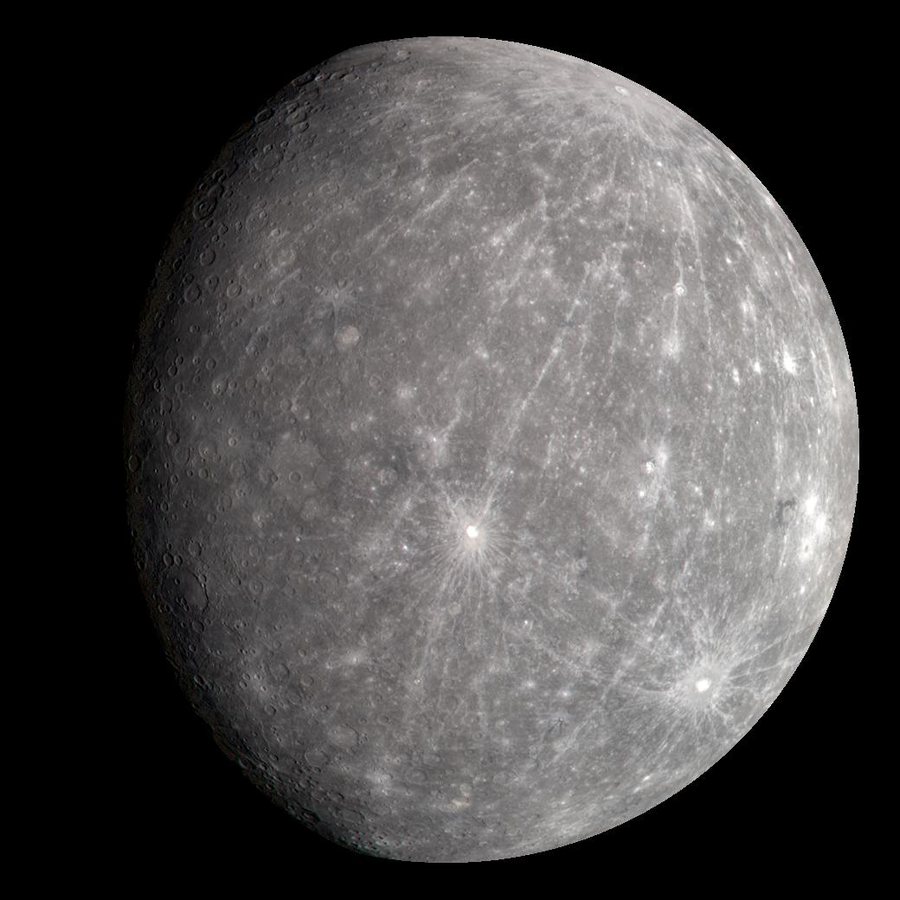
Mercury, the smallest planet in the Solar System, has contracted by nearly 19 kilometers (12 miles) across, according to new research led by the German Aerospace Center's Institute of Space Research. The finding suggests the planet has shrunk more than planetary scientists previously believed, and it points to a geological process that has been partially hidden from view.
The research indicates that crater debris has masked telltale wrinkles on Mercury's surface — the fault scarps and ridges that typically provide evidence of a shrinking planet. Because these features are obscured, earlier estimates of Mercury's contraction likely underestimated the true extent of its reduction in size.
Mercury's shrinkage is a long-recognized consequence of its thermal history. As the planet's interior cooled over billions of years, its rocky shell had to accommodate a smaller volume, forcing the crust to buckle and thrust upward along faults. These landforms, known as lobate scarps, are among the most direct evidence that the planet is still contracting, albeit extremely slowly by human standards.
The new estimate of nearly 19 kilometers across represents a significant revision. If confirmed by further observation and modeling, it would mean Mercury has lost more of its original diameter than prior assessments suggested, with implications for how scientists understand the planet's internal cooling rate and the strength of its lithosphere.
The German Aerospace Center's Institute of Space Research led the work, which adds to a growing body of evidence that Mercury's surface record is more complicated than it appears. Crater debris — material ejected and redistributed by impacts over eons — can bury or soften the tectonic signatures that researchers rely on to measure contraction. That masking effect helps explain why the planet's true shrinkage has remained uncertain.
Mercury is the closest planet to the Sun and the smallest of the eight planets, with a diameter of roughly 4,880 kilometers. Its heavily cratered surface resembles the Moon's, but its tectonic history is distinctive. The planet has no active plate tectonics like Earth; instead, its crust responds to cooling by thrust faulting, producing cliffs that can stretch for hundreds of kilometers.
Because Mercury is difficult to observe from Earth and only a few spacecraft have visited it, each new analysis of its surface carries weight. The research underscores how impact processes can obscure geological evidence and why continued study of the planet's crust is needed to pin down its thermal and structural evolution.
The finding also has broader relevance for planetary science. Understanding how Mercury contracted helps researchers model the cooling histories of other rocky bodies, including the Moon and Mars, and refines expectations for how a planet's surface records internal change over billions of years.
For now, the revised figure of nearly 19 kilometers across stands as the latest estimate of Mercury's contraction, with crater debris identified as a key factor that had hidden the evidence. Further observations and analysis will be needed to confirm the extent of the shrinkage and to map where the obscured faults lie.