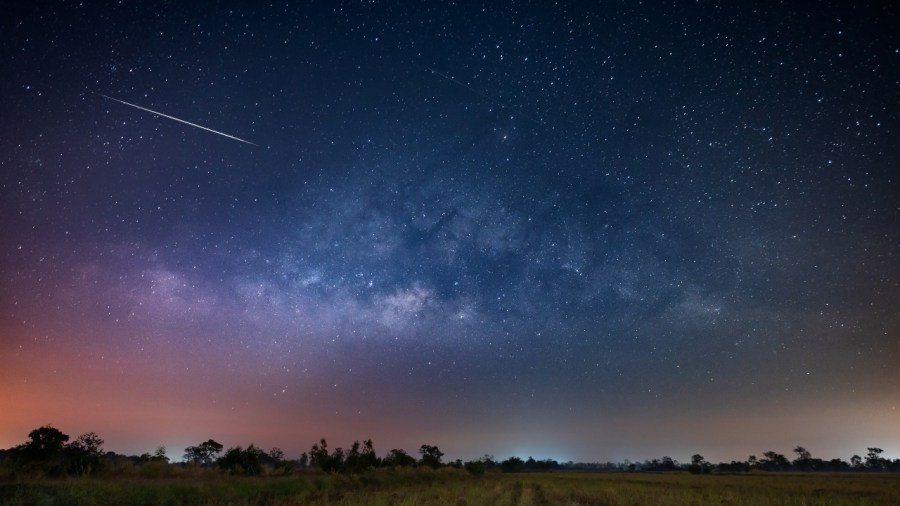
The Orionids, widely regarded as one of the best meteor showers of the year, are now underway, giving skywatchers across the United States a chance to catch fast, bright shooting stars over the coming weeks.
The shower is active each October and is produced by debris left behind by Halley's Comet, the famous icy body that last passed through the inner solar system in 1986. As Earth crosses the comet's dusty trail, tiny particles strike the upper atmosphere at high speed and burn up, creating the streaks of light known as meteors.
Orionid meteors are known for their speed. They enter the atmosphere at roughly 41 miles per second, according to standard astronomical measurements, which makes them appear as quick, sharp flashes rather than slow, lingering trails. At their best, the shower can produce around 20 visible meteors per hour under dark skies, though the actual count varies from year to year.
The shower takes its name from the constellation Orion, because the meteors appear to radiate from a point near the club of Orion the Hunter. That radiant point rises in the eastern sky late in the evening and climbs higher toward dawn, which is generally the best time to look. The shower's peak typically falls around October 20 to 22, but meteors can be seen on nights before and after the maximum.
For observers in the United States, viewing conditions depend heavily on moonlight and local weather. A bright moon can wash out fainter meteors, so the darkest possible sky is an advantage. Experts recommend finding a location away from city lights, allowing the eyes to adjust to the darkness for at least 20 to 30 minutes, and then looking up rather than focusing on any single part of the sky. No telescope or binoculars are needed; the shower is best seen with the naked eye.
Skywatchers should also dress for cool autumn temperatures and bring a chair or blanket, since the most comfortable way to watch a meteor shower is to lie back and scan as much of the sky as possible. Patience matters: meteors arrive in bursts, with quiet stretches between visible streaks.
The Orionids are one of two annual showers linked to Halley's Comet. The other, the Eta Aquariids, appears in May. Together they offer a recurring reminder of the comet's long orbit, even in years when the comet itself is far from Earth.
This year's Orionids arrive as part of a busy season for skywatchers, with several other celestial events drawing attention in October. The shower remains visible for roughly a week on either side of its peak, though the number of meteors drops noticeably away from the maximum.
For anyone hoping to see the Orionids, the practical advice is simple: check the weather forecast, pick a dark spot, give your eyes time to adapt, and look up. The shower rewards those who wait, and even a modest display can produce a handful of memorable streaks across the night sky.