Two young pygmy raccoons on Mexico’s Cozumel Island have been observed doing something researchers say has not previously been reported in raccoons: turning discarded paper into ball-shaped toys and then playing with them.
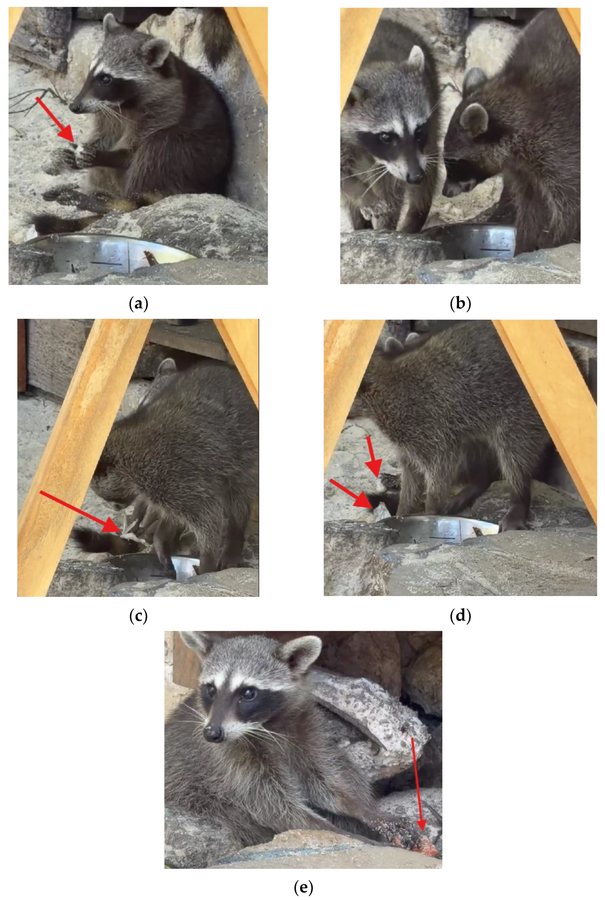
The behavior was documented during fieldwork at a beach club on Cozumel in January 2026. Researchers were studying how tourism affects the island’s critically endangered pygmy raccoon, Procyon pygmaeus, when two juvenile female siblings began retrieving receipts, napkins and food wrappers from a waste bin.
The animals carried the paper to a bowl of water, dipped it, placed it on the sand and repeatedly pressed, rolled and compacted the wet material with their forepaws. As sand adhered to the paper, it became denser and took on a roughly spherical shape. The raccoons then batted the balls across the ground, chased them and rolled them between their paws.
The observations were reported by Nessie O’Neil, Michelle Szydlowski and Noel Anselmo Rivas-Camo in the journal Wild. The researchers describe the behavior as preliminary evidence of material culture: object-related behavior that may be shaped by social learning rather than by an immediate need to obtain food.
Across 64 hours of observation, the team recorded 14 ball-making sequences. Eight ended with a completed ball, while six attempts were unsuccessful or incomplete. One of the juveniles performed the full sequence first. Her sister watched and made several unsuccessful attempts before later completing two balls independently, one from a food wrapper and another from a receipt.
That progression is suggestive, but the authors are careful about what it can prove. The observations came from a small number of related animals, were not part of a planned experiment and do not establish that the behavior is a lasting cultural tradition. They do, however, raise the possibility that one raccoon learned part of the sequence through watching another.
The researchers also compared the beach-club group with raccoons at another tourism site roughly 30 kilometers away. Young animals there also had access to paper waste and fresh water and were accustomed to people, yet the researchers did not see them making or playing with paper balls. That contrast supports the possibility that the behavior emerged locally rather than being a routine species-wide habit.
The paper includes one unusually specific observation involving the presumed mother of the two juveniles. She appeared to begin the sequence by placing a paper towel in water but abandoned the attempt when she could not retrieve it. Earlier, she had consumed about one ounce, roughly 30 milliliters, of a margarita. The authors write that the alcohol might have reduced her dexterity. The episode is presented as an observation rather than a controlled test, so it cannot establish a causal effect.
What makes the behavior scientifically interesting is not simply that the raccoons played. Object play is widespread in animals. The unusual element is the sequence of altering a material before using the modified object for a purpose unrelated to feeding. Raccoons are already known for tactile exploration and problem-solving, but research has focused heavily on foraging tasks. Deliberately transforming paper and then using the result in play expands the known behavioral repertoire of the group.
It also gives the observation a conservation dimension. The Cozumel pygmy raccoon is a distinct species found only on the island. It is classified as critically endangered, and its coastal habitat has been affected by roads, tourism infrastructure and other forms of development. At tourist sites, the animals also encounter discarded food, waste and substances they would not normally find in an undisturbed habitat.
The same human environment that may have created an opportunity for the paper-ball behavior therefore creates risks. Habituation to tourists, scavenging and exposure to inappropriate food or toxic substances can alter behavior and threaten individual animals. For a species with such a restricted range, the loss of a small local group can also erase behavioral variation before scientists have had a chance to understand whether it is learned, repeated or transmitted.
The researchers argue that long-term observation is needed to determine whether paper-ball making remains confined to one family or spreads among other raccoons. For now, the finding is best treated as a rare natural experiment: two young animals encountered a human-made material, changed it in a repeatable way and turned it into something they could play with.