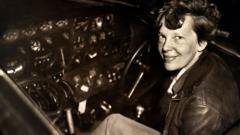
A research crew searching for the wreckage of Amelia Earhart's aircraft has arrived at a remote Pacific island whose giant coconut crabs may have played a role in the aviator's disappearance, the expedition has confirmed.
The team is working on and around Nikumaroro, a tiny atoll in the Phoenix Islands group of Kiribati, where Earhart and navigator Fred Noonan are widely believed to have landed after failing to reach Howland Island during their attempted round-the-world flight in 1937.
The island is home to a large population of coconut crabs, the world's largest land-dwelling arthropods, which can grow more than a metre across, lift heavy objects and crack open coconuts with their claws. Researchers have said the creatures may have disturbed or consumed human remains left on the island, complicating efforts to recover evidence of Earhart's final days.
To avoid the crabs, members of the expedition are sleeping aboard their ship rather than camping ashore, according to the team. The precaution reflects the practical difficulties of working on an uninhabited atoll where the wildlife is both abundant and unusually strong.
The search focuses on the possibility that Earhart's Lockheed Electra came down near the island after the pair failed to locate Howland Island, their planned refuelling stop, on 2 July 1937. The aviator and her navigator were declared lost at sea after an extensive search failed to find any trace of the aircraft or the crew.
Previous expeditions to Nikumaroro have uncovered artefacts that researchers have linked to Earhart, including fragments of clothing, a jar and pieces of metal. The current mission aims to gather further evidence that could confirm the island as the site of the disappearance.
Earhart was the first woman to fly solo across the Atlantic Ocean and a celebrated figure in the history of aviation. Her disappearance during the round-the-world attempt became one of the most enduring mysteries of the twentieth century, generating decades of speculation, books and searches.
The expedition is the latest in a series of attempts to solve the puzzle. Investigators have long debated whether the aircraft crashed into the ocean or whether Earhart and Noonan reached land and survived for a time before dying on an isolated island.
The coconut crabs of Nikumaroro have featured in that debate before. Researchers have suggested that the crabs, which are known to scavenge and can move large objects, may have dragged and scattered bones from a body, potentially explaining why so little physical evidence has been found.
The team's arrival marks the start of a new phase of fieldwork on the atoll. The crew is expected to survey the island and surrounding waters in the coming days as part of the effort to locate the aircraft and any remaining traces of the two aviators.
No definitive identification of the wreckage has been made, and the fate of Earhart and Noonan remains unconfirmed. The expedition's findings will be assessed against the existing body of evidence gathered from the island over many years.