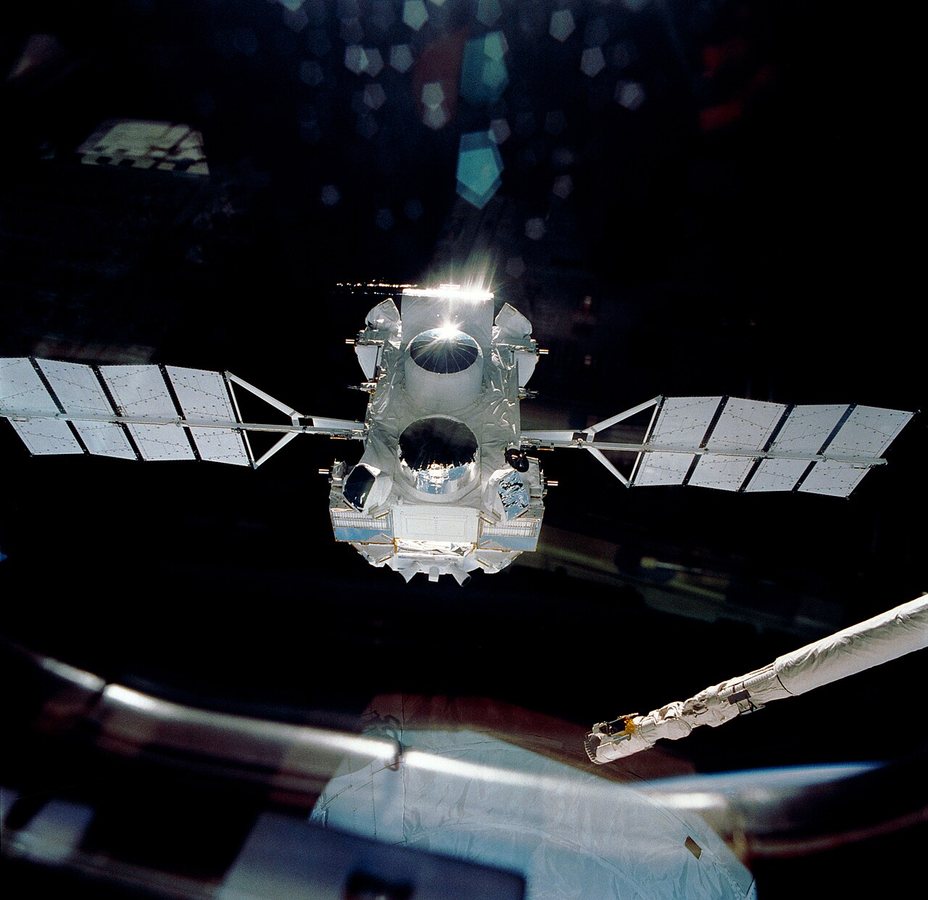
NASA's Swift space observatory is on its final path toward Earth. After more than two decades of research, the telescope is expected to re-enter the atmosphere around Friday, October 30, 2026, the US Space Force estimates, while its trajectory is being tracked closely.
Brad Cenko, the mission's chief scientist at NASA, said most of the spacecraft's structure, which weighs roughly 1.5 tons, will burn up during descent. Some tungsten components and fragments of its mirrors, however, could survive re-entry. Scientists consider any surviving debris likely to fall into the ocean. The predicted re-entry zone nonetheless covers parts of Africa, Australia, India, Southeast Asia, Central America and South America. Officials stress that no specific impact point has been confirmed, and the Space Force continues to monitor the observatory's orbit to determine its descent.
Swift's decline was accelerated by intense solar activity in recent years. That activity heated the upper atmosphere and increased atmospheric drag on satellites in low Earth orbit, steadily lowering the telescope's altitude. Because the drag was pulling the observatory closer to the ground faster than expected, the mission's timeline shortened. To try to extend its operation, NASA contracted the company Katalyst Space, which developed a robotic spacecraft called Link. The vehicle launched in July 2026 with the goal of approaching the telescope and boosting its orbit. It ran into technical difficulties and did not complete the operation. Link itself re-entered the atmosphere in September, and the rescue was called off.
Swift was launched on November 20, 2004, to investigate gamma-ray bursts and other high-energy phenomena in the universe. During its mission it detected more than 2,000 gamma-ray bursts and roughly 1,400 supernovas, and it also studied comets, asteroids and black holes. A central capability was its ability to rapidly reorient toward newly detected astronomical events and alert other observatories, including the Hubble and James Webb space telescopes, so they could conduct follow-up research. That rapid-response role made Swift a hub for time-sensitive astronomy, linking its own detections to a wider network of instruments.
After the rescue was canceled, Swift continued observations until October 20. At that point its low altitude no longer allowed its instruments to operate under the conditions they require, and NASA formally ended the mission. The observatory's shutdown closes a program that produced an extensive scientific record over more than two decades, a record that astronomers will continue to mine long after the spacecraft itself has been lost.