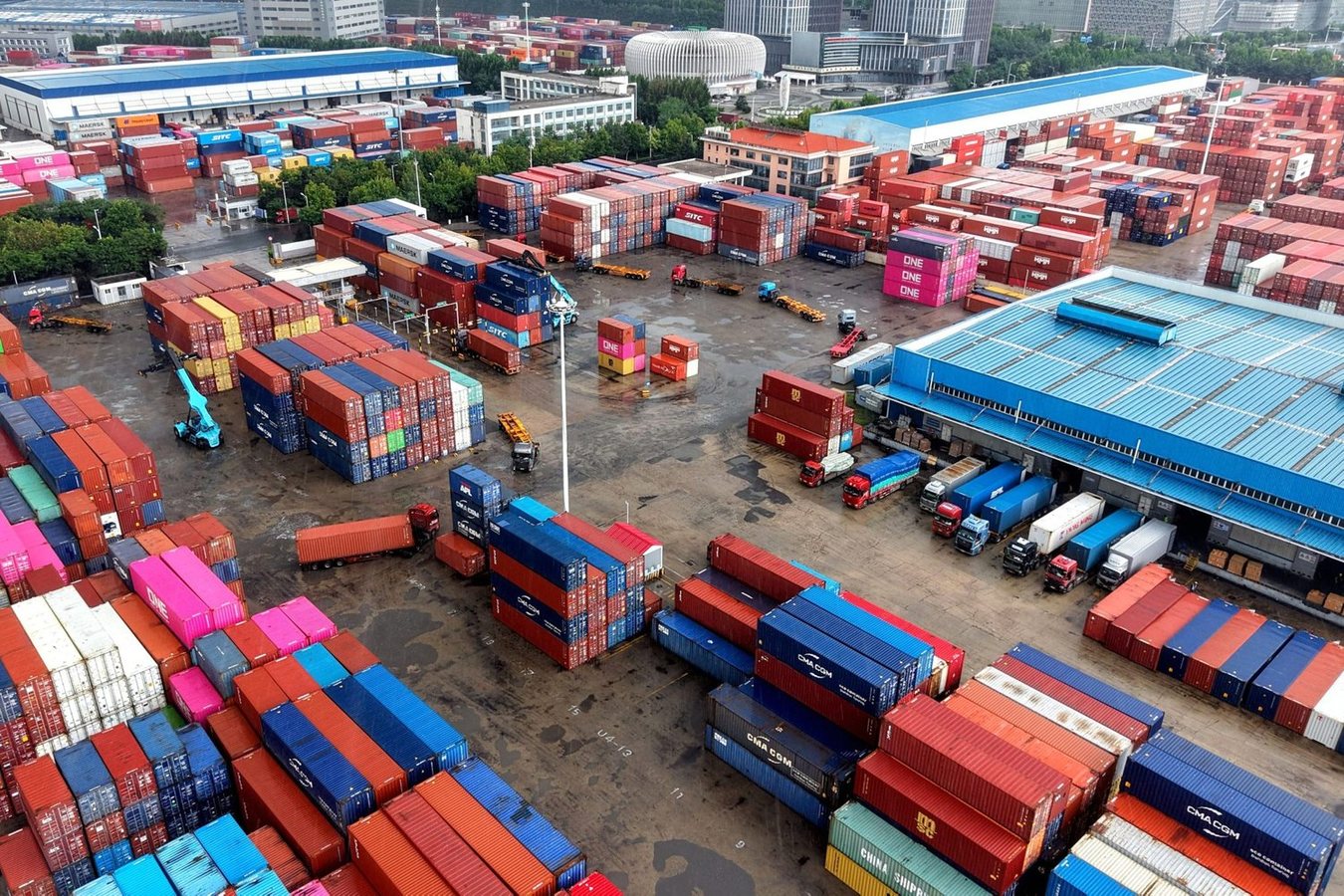
China’s exports jumped 25% in August from a year earlier, propelled by strong demand for autos and high-tech goods, as the country’s trade surplus widened further, according to customs data released Tuesday. The surplus expanded to $119.1 billion in August, up from $112.5 billion in July, putting the world’s second-largest economy on track for a new record-high trade surplus this year.
The data was broadly in line with economist expectations and arrives just ahead of a planned meeting between Chinese leader Xi Jinping and U.S. President Donald Trump, expected in late September. Beijing has not yet confirmed the exact date for the visit, but trade is anticipated to be among the key topics of discussion between the two leaders. The figures underscore the tensions Beijing faces as it relies on exports to fuel growth while its domestic economy struggles with sluggish consumption and investment following a yearslong real estate downturn.
China’s global imports climbed 28.2% in August from a year earlier, up from July’s 27.5% rise, while exports grew 23.9% year-on-year in July. Exports to the U.S. totaled $42.5 billion in August, up 34.4% year-on-year, in part due to a base effect after higher U.S. tariffs caused exports to fall last year. U.S. exports to China last month were $13.3 billion, leaving a trade surplus in China’s favor of about $29.2 billion, according to Chinese data. Exports to the EU rose 6.6%, while those to Southeast Asia and Latin America rose 30.2% and 17.5%, respectively.
Exports have consistently outpaced imports and are “set to lead to a new record-high trade surplus this year,” said Lynn Song, chief economist for Greater China at the Dutch bank ING. China has weathered disruptions from the Iran war better than many other countries, and it has been exporting more to Southeast Asia, Latin America and Africa, shielding it from the impact of higher U.S. tariffs. Exports of autos in August grew 43% year-on-year while semiconductor exports surged 129.8%, the customs data show.
“China is very competitive in its tech goods exports,” said Chi Lo, a senior market strategist for Asia Pacific at BNP Paribas Asset Management. In recent months, rising exports of electric vehicles, industrial machinery and semiconductors have helped fuel China’s robust shipments globally. “China has moved aggressively up the value chain and has become a major player in AI infrastructure and industrial automation,” he said.
Policymakers in the U.S. and elsewhere have raised concerns over China’s ballooning trade surplus, which surged to a record $1.2 trillion for the whole of last year. Beijing has said that it is not seeking to maximize its trade surplus. At home, China is still struggling to boost its economy as consumption and investment remained sluggish following a yearslong real estate sector downturn. On Sunday, China said it was injecting around $54 billion into state banks and insurers to help lift its economy.
China’s continued reliance on exports to fuel growth prompted 19 members of the Group of 20 large economies to agree to address such economic imbalances at a recent meeting of top financial officials in Asheville, North Carolina. China was the lone dissenting G20 member after U.S. Treasury Secretary Scott Bessent described China’s trade surplus as a barrier to global economic growth.
The strategic stalemate between China and the U.S. will likely remain, said Lo of BNP Paribas. “Both sides hold each other hostage in some strategic products, with the U.S. withholding high-end tech goods from being sold to China and China withholding rare-earth exports to the U.S.,” he said. China and the EU are also set to meet for ministerial level trade talks in the fall, as the EU struggles to reduce its roughly 1 billion euros-a-day trade deficit with China. The EU implemented measures in July to protect its steel industry and has limited tax-exempt imports of Chinese e-commerce small parcels.