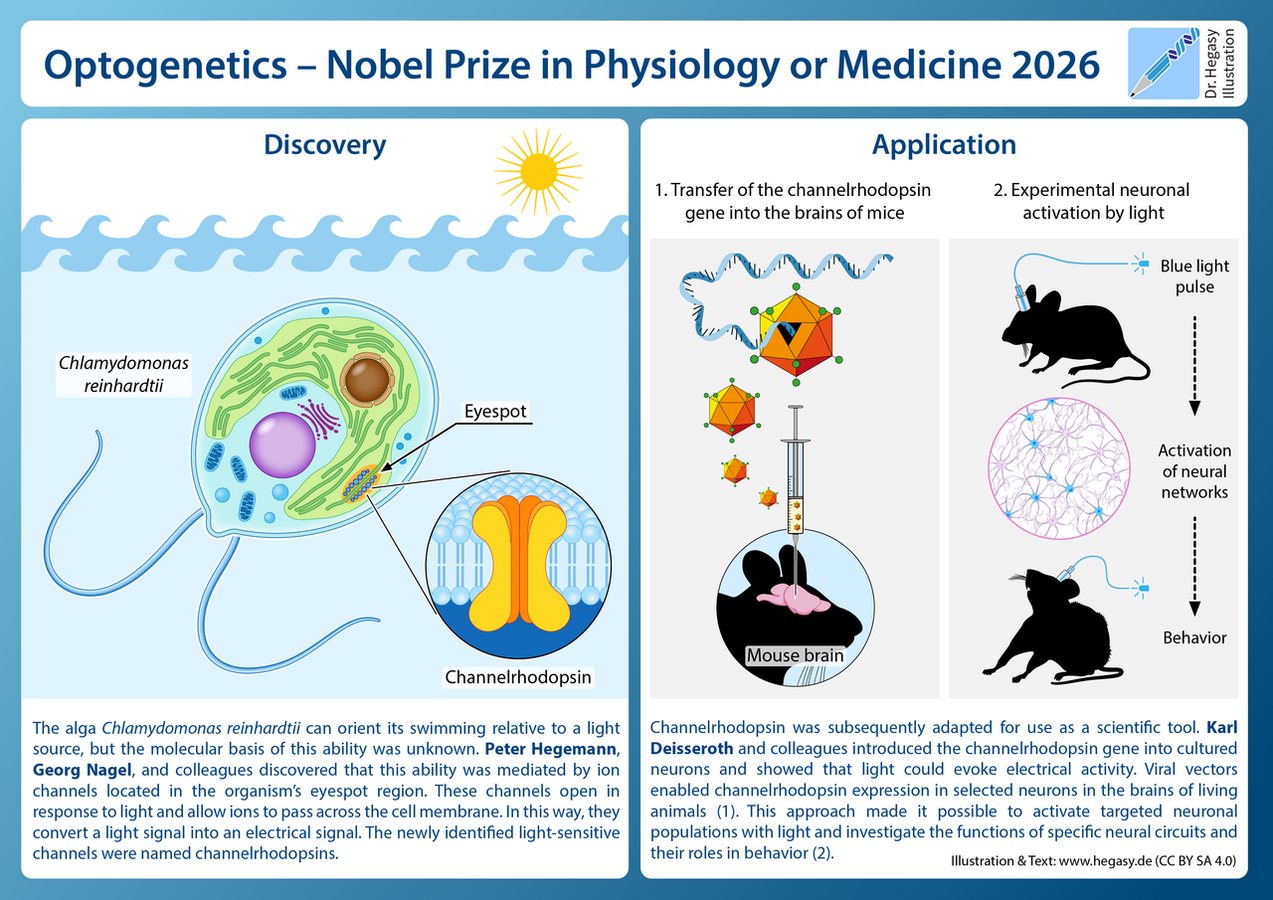
Optogenetics, a technique that uses light to control individual brain cells, has become one of the most transformative tools in modern neuroscience. The method, which earned the 2021 Nobel Prize in Physiology or Medicine for researchers David Julius and Ardem Patapoutian, allows scientists to turn specific neurons on or off with a flash of light, offering a level of precision that traditional electrical stimulation or drugs cannot match.
The approach works by inserting light-sensitive proteins, called opsins, into neurons. These proteins, originally found in algae and other microorganisms, act as ion channels that open or close in response to specific wavelengths of light. When a neuron expresses an opsin, researchers can shine a laser or LED onto it and trigger or silence electrical activity almost instantly. Because the genetic instructions for these proteins can be targeted to precise cell types, optogenetics lets scientists manipulate defined circuits without disturbing neighboring cells.
The technique has already reshaped the study of brain function. Laboratories worldwide use it to map the neural pathways behind memory, reward, fear, and movement. By switching specific cells on or off in living animals, researchers can observe how behavior changes in real time, establishing cause-and-effect relationships that were previously impossible to test. This has led to new insights into conditions such as Parkinson’s disease, depression, anxiety, and addiction, where abnormal activity in particular circuits is thought to play a central role.
Beyond basic research, optogenetics is moving toward clinical applications. Early trials have explored using light to restore vision in people with degenerative retinal diseases, and researchers are investigating whether the method could one day treat chronic pain, epilepsy, and movement disorders. The challenge remains delivering light-sensitive genes safely and getting light into deep brain regions without invasive surgery. Newer opsins that respond to red light, which penetrates tissue more effectively, and tiny implanted LEDs are helping to overcome these barriers.
The 2021 Nobel Prize recognized the discoveries of receptors that allow the body to sense temperature and touch, but optogenetics itself emerged from decades of work on microbial rhodopsins and was pioneered as a brain-control tool in the mid-2000s. Its rise reflects a broader trend in science: the fusion of genetics, optics, and engineering to interrogate living systems with unprecedented control. As the technology matures, it promises not only to deepen our understanding of the brain but also to deliver new therapies for some of the most difficult neurological and psychiatric conditions.