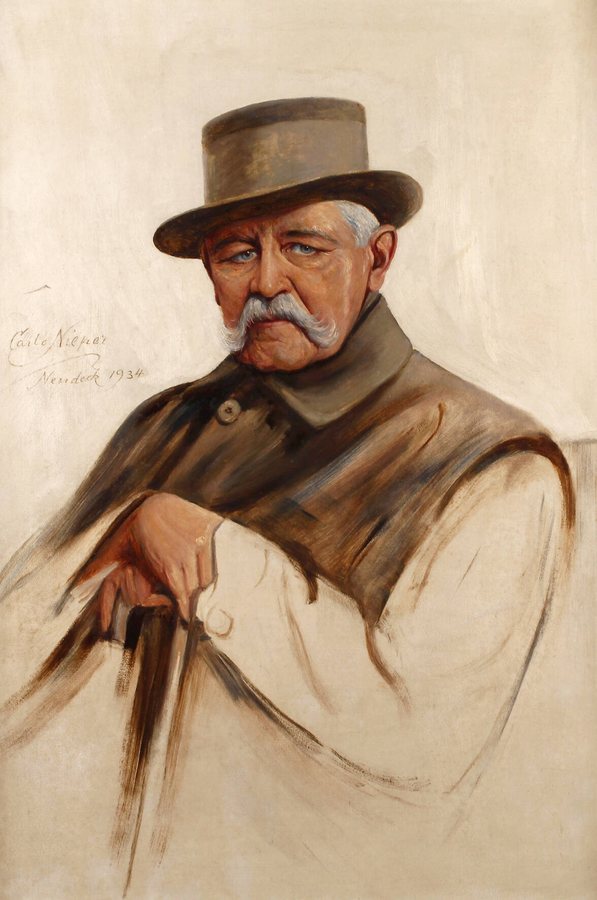
Paul von Hindenburg, the German field marshal and second president of the Weimar Republic, was born 179 years ago, on 2 October 1847, in Posen, then part of the Kingdom of Prussia. His life spanned the unification of Germany, the First World War, the collapse of the monarchy, and the rise of the Nazi regime, making him one of the most consequential and contested figures in modern German history.
Hindenburg was born into an aristocratic Prussian family with a long tradition of military service. He joined the Prussian Army as a young officer and saw action in the Austro-Prussian War of 1866 and the Franco-Prussian War of 1870–71. Over the following decades he rose steadily through the ranks, retiring in 1911 after a career that seemed to have reached its natural end.
The outbreak of the First World War in 1914 brought him back to active duty. Appointed commander of the Eighth Army in East Prussia, he won a decisive victory at the Battle of Tannenberg in August 1914, a triumph that made him a national hero. Together with his chief of staff, Erich Ludendorff, he later directed German operations on the Eastern Front and, from 1916, exercised sweeping authority over the entire war effort as chief of the General Staff. His reputation as the «victor of Tannenberg» became a powerful symbol of German military prowess, even as the war ended in defeat and the monarchy fell in 1918.
After the war, Hindenburg retired from public life, but the political turmoil of the young Weimar Republic drew him back. In 1925, at the age of 77, he was elected president as the candidate of the political right, succeeding Friedrich Ebert. Although he had sworn an oath to the democratic constitution, he governed largely through conservative advisers and used emergency decrees to bypass parliament during the economic and political crises of the early 1930s.
His re-election in 1932, at 84, came at a moment of extreme polarization. In January 1933, he appointed Adolf Hitler as chancellor, a decision that would prove fateful. Hindenburg died on 2 August 1934 at his estate in Neudeck, West Prussia. His death removed the last institutional barrier to Hitler's consolidation of total power, and the office of president was abolished shortly afterward.
Hindenburg remains a deeply ambiguous figure. For many Germans of his era, he embodied duty, stability, and military honor. For later historians, his presidency illustrates the fragility of the Weimar Republic and the fatal consequences of conservative elites underestimating the Nazi movement. His birthplace in Posen, now Poznań in Poland, and his burial place in Marburg continue to attract historical interest.
The anniversary of his birth offers an occasion to reflect on how personal authority, institutional loyalty, and political judgment intersect in moments of national crisis. Hindenburg's long life connected the age of Bismarck to the threshold of the Second World War, and his decisions continue to shape debates about responsibility, memory, and the lessons of the twentieth century.