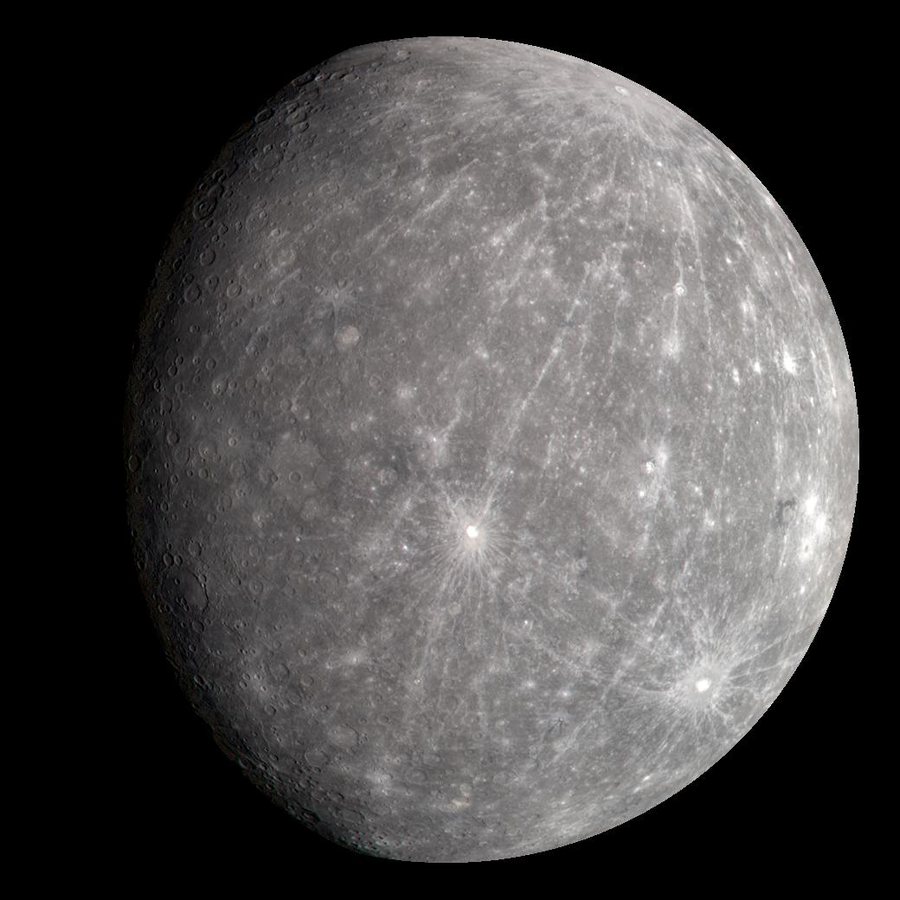
Mercury lives in a harsh neighborhood. It orbits close to the Sun, has only a weak global magnetic field and lacks the thick atmosphere that shields Earth from much of the solar particle environment. During a close BepiColombo flyby, scientists obtained a direct look at what happens when a strong stream of energetic protons and electrons meets that limited protection.
The observations came during BepiColombo's fourth Mercury flyby, when the spacecraft passed about 165 kilometres above the surface. Instruments recorded elevated fluxes of solar energetic particles while the spacecraft moved through different parts of Mercury's magnetosphere. The geometry allowed researchers to track how charged particles were filtered, deflected or able to penetrate toward the planet.
On Earth, a large magnetosphere and atmosphere absorb or redirect most solar energetic particles before they can reach the ground. Mercury is different. Its magnetic cavity is small enough that energetic particles can interact with the surface much more directly. Repeated bombardment can alter surface minerals, release atoms into the extremely thin exosphere and contribute to the long-term process known as space weathering.
The flyby therefore links plasma physics to geology. Mercury's surface is not isolated from the space environment; it is continually processed by solar radiation, micrometeoroids and charged particles. Understanding the relative importance of those mechanisms is essential for interpreting remote-sensing measurements of composition and for explaining how the exosphere is replenished.
The result also has significance beyond Mercury. Many rocky exoplanets orbit much closer to their stars than Earth does. Some may have weak magnetic fields or no substantial atmospheres. Direct observations of Mercury provide a nearby laboratory for asking how intense stellar particle environments affect exposed rocky surfaces over geological time. The details will differ from system to system, but the governing processes can be tested here.
BepiColombo is a joint European-Japanese mission that will eventually enter orbit around Mercury after a complex sequence of planetary flybys. The close passes used for gravity assists have already functioned as scientific experiments, sampling regions that will later be studied more systematically from orbit.
Once the mission begins its dedicated orbital phase, researchers will be able to connect particle measurements with surface composition, magnetic structure and exospheric changes over time. The flyby result shows why those combined observations matter: on a small planet close to the Sun, space weather is not only something happening above the surface. It can be part of the surface's continuing evolution.