A nuclear detonation over or near a modern American city would not produce one clean circle of destruction. It would create overlapping zones of blast, heat, prompt radiation, fires and fallout, each shaped by the weapon, the altitude of the burst, local construction, terrain and weather.
That is why the most useful way to understand the risk is not to ask for a single “blast radius.” It is to ask what systems fail, in what sequence, and how many of the systems needed for rescue are damaged at the same time.
The scenario is not purely theoretical. Russia retains a mature nuclear triad capable of threatening the United States. Open-source estimates from the Federation of American Scientists identify land-based RS-24 Yars intercontinental ballistic missiles, Borei-class ballistic-missile submarines with Bulava missiles, and Tu-160 and Tu-95MS strategic bombers as major components of the force. FAS estimated that roughly 1,718 Russian strategic warheads were deployed in 2025.
SIPRI's 2026 assessment concluded that Russia and the United States together still held about 83 percent of the world's stockpiled nuclear warheads. It also found that both countries were continuing modernization programs even as the arms-control structure weakened.
The strategic question — whether nuclear deterrence prevents those weapons from ever being used — is separate from the physical question of what happens if deterrence fails.
Federal U.S. guidance uses a range of hypothetical detonations to prepare responders. One widely used planning case is a 10-kiloton near-surface explosion. In that model, HHS describes a severe-damage zone extending roughly half a mile from the detonation, a moderate-damage zone out to about one mile, and a light-damage zone reaching roughly three miles. These are planning approximations, not universal laws.
Inside the severe zone, few buildings are expected to remain structurally sound. Streets can become impassable under rubble, and very few people exposed in the open would survive the combined blast, heat and radiation. Even underground or heavily shielded survivors may be trapped.
The moderate zone may produce the largest concentration of people who can still be saved with urgent treatment. Buildings can be partly collapsed, interiors blown out, utility lines severed, cars overturned and fires scattered across the area. The same streets needed by ambulances and fire engines may be blocked by debris.
Farther out, broken windows and flying glass become major injury mechanisms. That sounds less dramatic than the central collapse zone, but in a dense city it can create a very large number of casualties over a broad area.
Then comes fallout.
A surface or near-surface burst pulls radioactive material and debris into the rising cloud. As particles descend, they form an irregular downwind contamination pattern rather than a symmetrical ring. Federal guidance stresses that weather strongly influences where dangerous radiation levels appear. The most hazardous fallout is often concentrated in the early hours, precisely when people may be tempted to flee.
This is why CDC's core public instruction is “get inside, stay inside and stay tuned.” A substantial building — especially a basement or interior area with many walls between a person and the outdoors — can sharply reduce radiation exposure. Moving immediately through an unknown fallout path can be more dangerous than sheltering first and waiting for official guidance.
The physics also explains why city-by-city casualty claims vary so widely. New York, Los Angeles, Chicago, Houston and Washington differ in population density, building construction, underground space, road networks and weather. A detonation that is an airburst will distribute energy differently from one at ground level. A larger-yield weapon changes the balance between heat and blast. Wind can move fallout away from the densest part of a city or toward it.
For that reason, there is no responsible single number for “how many would die” in each major city without defining a very specific scenario. What can be stated is the pattern: the central area can suffer catastrophic structural destruction; burns and blast injuries can extend well beyond it; fires can multiply; and fallout can threaten people outside the visibly devastated zone.
The next scientific problem is medical capacity.
Radiation injury is not the only burden. Many casualties would have combined trauma: burns, fractures, lacerations, crush injuries, inhalation injury and radiation exposure. Those combinations are difficult to treat even in an intact health-care system.
HHS guidance assumes the opposite of an intact system. Hospitals near the detonation may be damaged or without power and water. Ambulance routes may be blocked. Staff may be injured, caring for family members or unable to travel. Communications may be unreliable. Supplies may run out. Under those conditions, hospitals can be forced into crisis standards of care, allocating scarce resources according to which patients are most likely to benefit.
The federal government maintains countermeasures for radiological and nuclear emergencies in the Strategic National Stockpile, including drugs used to treat some forms of radiation injury and contamination. Federal guidance says those resources can be deployed rapidly after a decision is made. But a stockpile is not the same as treatment at the bedside. States and local systems still have to receive, stage and distribute supplies while roads, staff and communications may be impaired.
That logistical gap is one reason preparedness remains uneven. GAO reported in February 2026 that the Department of Health and Human Services was funding both public-health and hospital emergency-preparedness programs but still had coordination weaknesses, including missed opportunities for joint exercises. Other GAO reviews have documented public-health workforce shortages.
The United States therefore has a technically sophisticated response architecture without having a physically hardened civilian society.
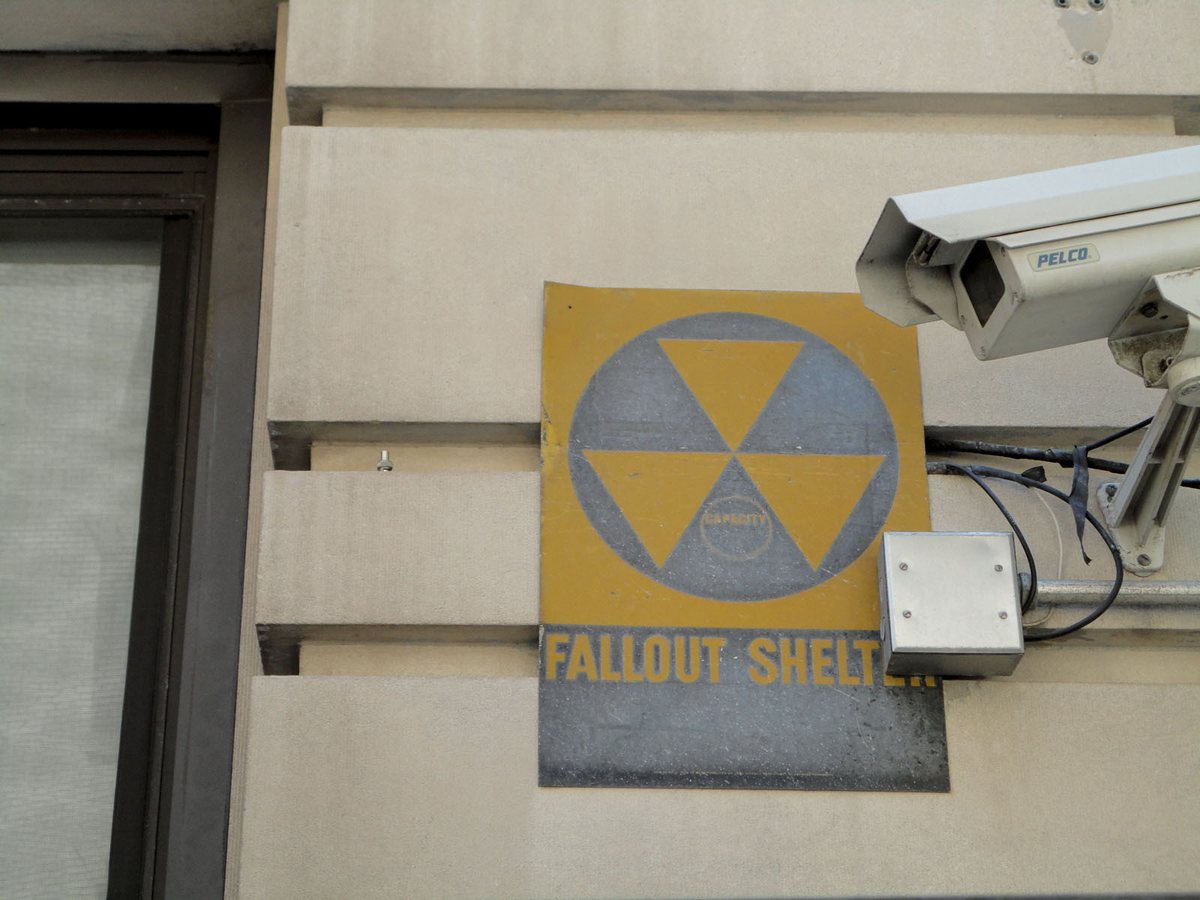
The old yellow-and-black fallout shelter signs are mostly historical artifacts. Modern guidance does not assume that every family can reach a designated, stocked, purpose-built shelter. It assumes people will use the best protective building available nearby.
That can work surprisingly well for many people outside the immediate blast zone, because shielding matters. But it depends on public knowledge and on communications delivering the right message quickly. If residents mistakenly evacuate through a fallout plume, if a building is lightly constructed, or if an alert never arrives, the same nuclear event can produce very different outcomes for people separated by only a few blocks.
A single detonation would be a national emergency. Several detonations in major metropolitan areas would create something qualitatively different: a system-wide shortage of trauma care, burn beds, radiation expertise, transport, utility crews and federal response personnel.
That is the scientific meaning of “not ready.” It does not mean the United States lacks plans or resources. It means the scale and coupling of nuclear effects are larger than the spare capacity built into ordinary civilian systems.
The most effective preparedness measures are therefore the ones that add resilience across multiple failure modes: stronger emergency communications, better public shelter knowledge, protected backup power and water for hospitals, regular radiation-response training, preplanned regional patient movement and logistics systems that can function when normal digital networks are down.
Those measures cannot make a nuclear detonation survivable for everyone near the center. They can, however, change outcomes for the much larger population outside the most heavily destroyed zone — the people for whom minutes of correct information and a few layers of concrete can still make the difference.