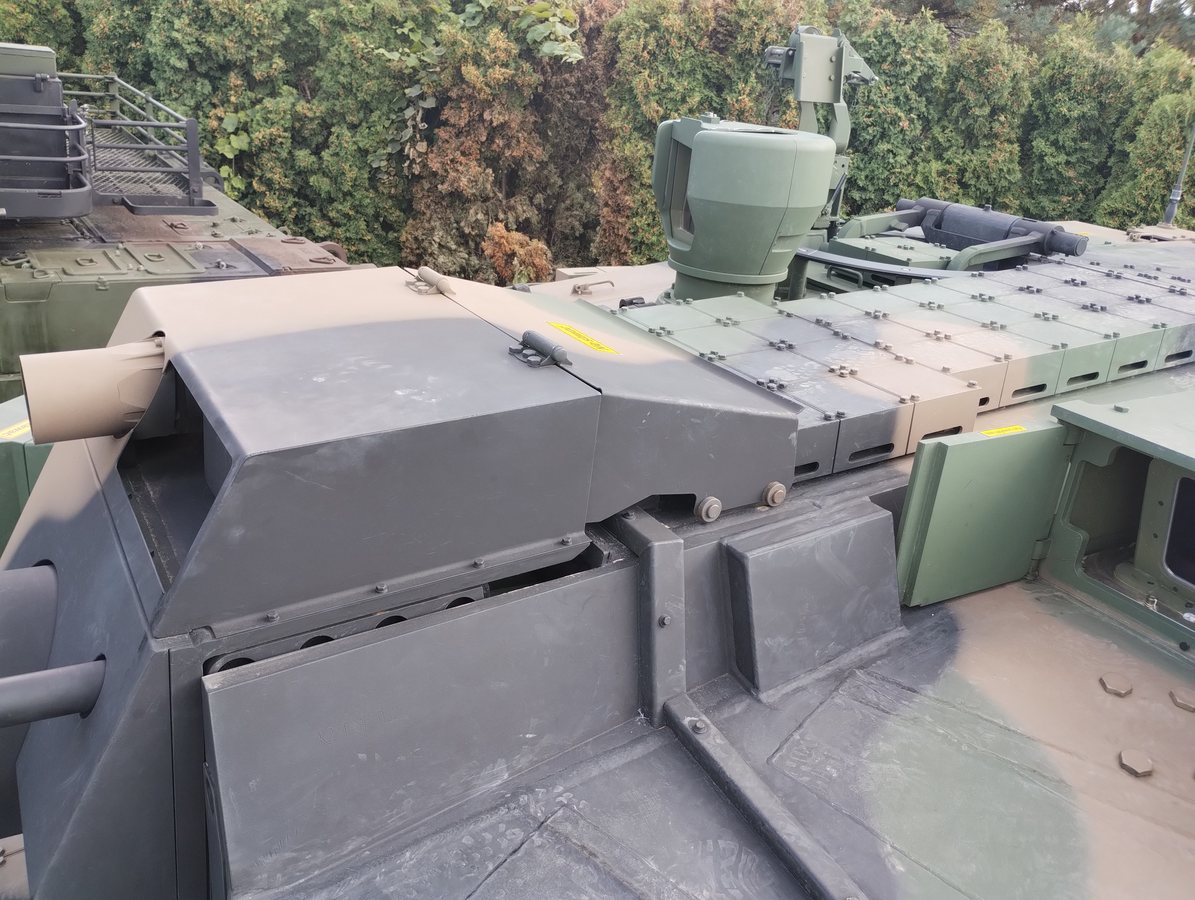
Poland has received the first 28 K2 main battle tanks under its second executive contract with South Korea’s Hyundai Rotem. The vehicles are bound for the 16th Mechanised Division, the formation responsible for north-eastern Poland and a part of the country’s land forces positioned close to Russia’s Kaliningrad region.
Defence Minister Władysław Kosiniak-Kamysz announced the arrival on 25 August, describing it as another step in strengthening Poland’s security and industrial capacity. His statement did not announce new intelligence that Russia was preparing an imminent attack on NATO. The delivery fits a procurement programme that has been building for years.
That distinction matters because the story is larger than a sudden movement of tanks to a border. The new vehicles remain on Polish territory and are being assigned to an existing Polish division. The geographic signal is real, but so is the longer industrial sequence behind it.
The second executive contract, signed on 1 August 2025, covers 180 K2 tanks. Of those, 116 are K2GF vehicles scheduled for delivery in 2026 and 2027. Another 64 will be K2PL, a Polish-tailored configuration expected between 2028 and 2030. The figure of 64 therefore refers to the K2PL subset, not to the total number of tanks in the agreement.
A separate 81-vehicle support package sits alongside the tanks. It includes 31 armoured recovery vehicles, 25 engineer vehicles and 25 bridge-laying systems. Those platforms are less visible than a new tank battalion, but they determine whether heavy units can recover damaged vehicles, cross obstacles and sustain manoeuvre.
The industrial route is just as important. Poland plans to produce 61 of the 64 K2PL tanks at Bumar-Łabędy in Gliwice. The first three are to be manufactured in South Korea and used to test the modified configuration. The K2PL package is expected to add protection, including an active protection system, anti-drone measures and additional armour.
The August shipment lifts the number of K2s delivered to Poland to 208. A first executive contract for 180 tanks, signed in 2022, was completed in November 2025. Across the two executive deals, Poland has therefore ordered 360 K2 tanks, even before considering the broader framework ambitions discussed earlier in the programme.
The less visible part of the contract may ultimately decide how much of that fleet is available at any one time. Training packages, spares, diagnostic equipment and maintenance tools are what turn delivered hulls into deployable units. Recovery and engineer vehicles are also essential when a heavy formation has to keep moving under difficult conditions rather than operate from a fixed base.
This is where a bilateral procurement arrangement becomes a strategic network. South Korean production is providing near-term volume, while Poland is attempting to absorb technology, maintenance capacity and final production. At the same time, the equipment is flowing toward the part of the country most directly tied to NATO’s north-eastern land defence.
The arrangement also reduces the distance between the user and the industrial base. If Bumar-Łabędy can assemble, service and eventually modernise the K2PL fleet at scale, Poland gains more control over availability and upgrades. For NATO, that matters because a resilient eastern flank depends on repair capacity and supply chains as much as on headline equipment numbers.
The next milestones will show whether the model works as intended: continued K2GF deliveries, integration of the support fleet and the start of serial K2PL production in Poland. If those stages stay on schedule, Warsaw will have done more than add tanks near Kaliningrad. It will have built a supply and industrial system designed to keep a larger armoured force operating on NATO’s eastern flank.