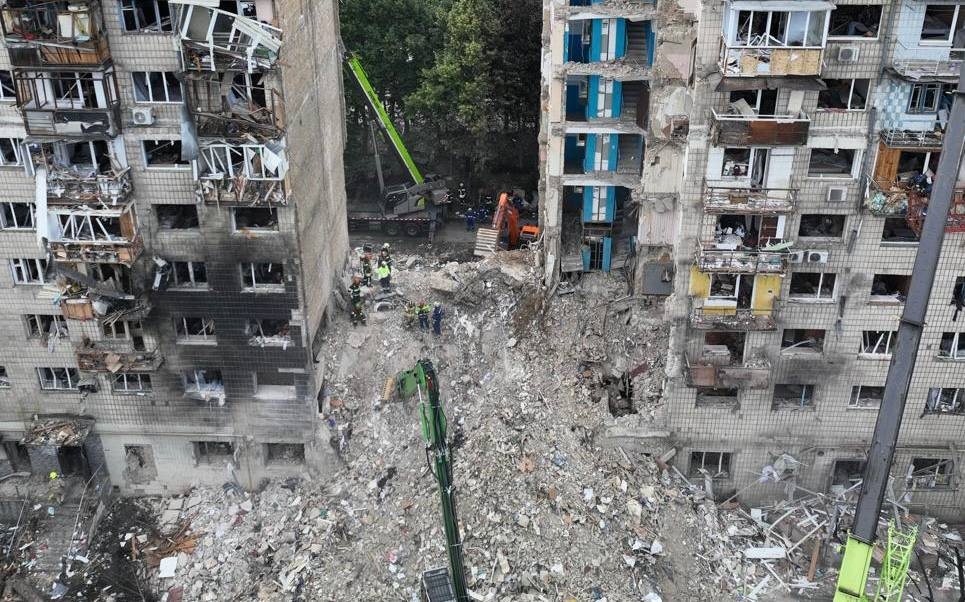
Russian missile and drone attacks hit Kyiv from the night into the afternoon on Sept. 8, killing five people and injuring at least 29, according to Ukrainian authorities and local reporting. The strikes damaged homes, a school, a medical facility and other civilian infrastructure across several districts of the capital.
The day began with emergency crews responding to a large overnight barrage. Later, fresh strikes hit the city again. By early evening, Ukrainian officials said two more people had been killed in a daytime attack on warehouse facilities, bringing the death toll for the day to five. The Kyiv Independent reported 29 people wounded.
The physical damage spread well beyond a single impact site. Kyiv authorities reported damage to 14 apartment buildings, a dormitory, a school, a clinic, roughly 25 vehicles, a supermarket, a gas station, warehouses and an entrance to the metro. The damage was recorded in seven districts, showing how the attack affected multiple parts of a city of millions rather than one isolated neighborhood.
Ukraine’s Air Force described the overnight phase as a broad combined attack. It said Russia launched 166 drones, 32 Kh-101 cruise missiles, an Oniks missile and several ballistic missiles. Ukrainian defenses intercepted or suppressed 175 targets, while strikes were recorded at 29 locations. Those figures are Ukraine’s official account of the attack and have not been independently reconstructed in full.
The timing added a diplomatic layer to the destruction. The Associated Press reported that the renewed strikes followed a short lull around visits by U.S. envoys Jared Kushner and Steve Witkoff to Moscow and Kyiv. The diplomatic effort had raised attention around possible ways to reduce the intensity of the war, but the air campaign resumed as those contacts continued.
That contrast matters for Washington and other Ukrainian partners because air defense remains one of Kyiv’s most immediate requests. Large mixed barrages are designed to force defenders to track drones, cruise missiles and ballistic missiles at the same time, while the supply of interceptors is finite. Ukraine has been pressing allies for more Patriot systems, additional interceptors and European SAMP/T equipment ahead of winter.
For residents, however, the immediate consequences were much less abstract. Emergency workers spent the day clearing debris and responding to damaged residential and public buildings while air alerts repeatedly interrupted movement around the city. The hit to a building used by Ukrainian television outlets also showed how the day’s strikes reached workplaces and media facilities as well as housing.
The Sept. 8 attacks leave two parallel tracks moving forward. Diplomats will continue to test whether the current talks can produce any restraint, while Kyiv will keep asking partners for the weapons needed to protect the capital if they do not. For people in the city, the next measure of progress is more basic: whether the damaged homes, school, clinic and transport infrastructure can be restored before another wave of strikes arrives.