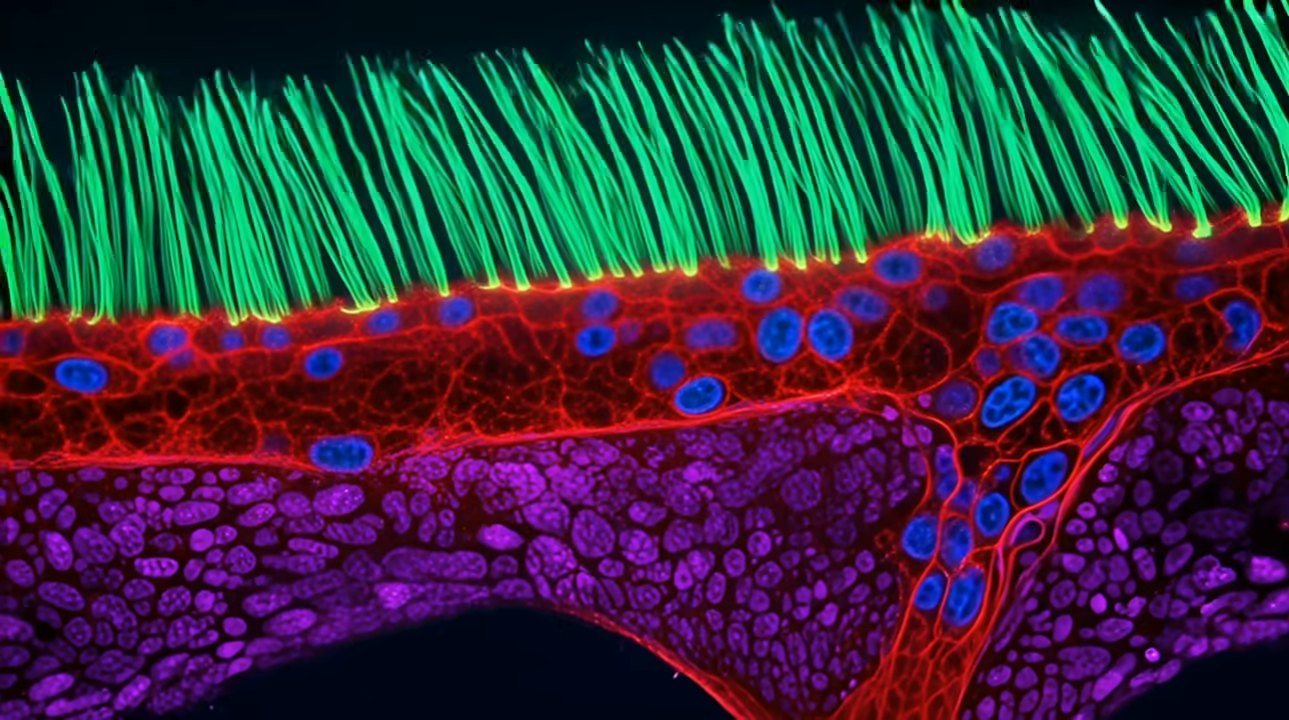
Nikon has disqualified the original first-place entry in its Small World in Motion video competition after concluding that the winning submission did not comply with the contest's rules on generative artificial intelligence. The decision follows an online backlash over the authenticity of the footage, which had been presented as a record of living biology.
The video, submitted by Dr Ning Xu, was described as showing tiny, hair-like structures called cilia moving in the airway of a child with the respiratory condition primary ciliary dyskinesia (PCD). Such footage would ordinarily represent a significant technical achievement, capturing microscopic motion at a scale and clarity that the competition was designed to celebrate.
Nikon said last week that it was reviewing the entry after scepticism spread online about whether the images were genuine. In a comment posted on LinkedIn, Dr Xu acknowledged the use of AI, stating that an unsupervised neural-network method had subsequently been used for AI-assisted post-processing to distinguish and visualise the structures. The admission confirmed the concerns that had circulated among observers of the competition.
The company has now ruled that the video breached its competition rules regarding generative AI. The disqualification removes the top honour from an entry that had already attracted attention well beyond the specialist microscopy community, turning a niche scientific contest into a broader debate about where the line falls between image enhancement and fabrication.
Small World in Motion is one of the better-known showcases for microscopy, and its results are widely shared among researchers, educators and science communicators. Entries are expected to represent what was actually observed through the lens, with post-processing limited to adjustments that do not alter the underlying scientific content. The use of neural-network methods to separate and highlight structures sits uneasily with that expectation, because the resulting image is no longer a straightforward record of the specimen.
The case also highlights a growing tension across scientific publishing and imaging competitions. AI tools are increasingly used to clean up noisy data, sharpen faint signals and make complex structures legible to non-specialists. Those same tools can, however, introduce or emphasise features that were not present in the original sample, making it difficult for judges and audiences to tell where observation ends and interpretation begins.
Nikon's decision to review the entry came only after external scrutiny, rather than through its own initial checks. That sequence has prompted questions about how competitions verify submissions in an era when sophisticated processing is widely accessible. Organisers of similar contests may now face pressure to tighten declaration requirements, request raw footage or require entrants to disclose any algorithmic steps taken during production.
For Dr Xu, the outcome is a reversal of a prominent result. The video had been celebrated as a striking visualisation of respiratory biology before the AI disclosure emerged. The disqualification means the first-place position will pass to another entrant, though Nikon has not indicated how it will handle the remainder of the ranking.
The episode carries implications beyond a single award. Scientific images are frequently used in teaching, public communication and policy discussions, and their authority rests on the assumption that they depict real observations. When AI-assisted methods are involved, that assumption requires explicit disclosure so that audiences can judge the evidence for themselves.
Nikon's ruling makes clear that generative AI falls outside what its competition permits. The wider question, for researchers, publishers and the public alike, is how institutions should handle a technology that can make the invisible visible while also making it harder to know what was truly there.