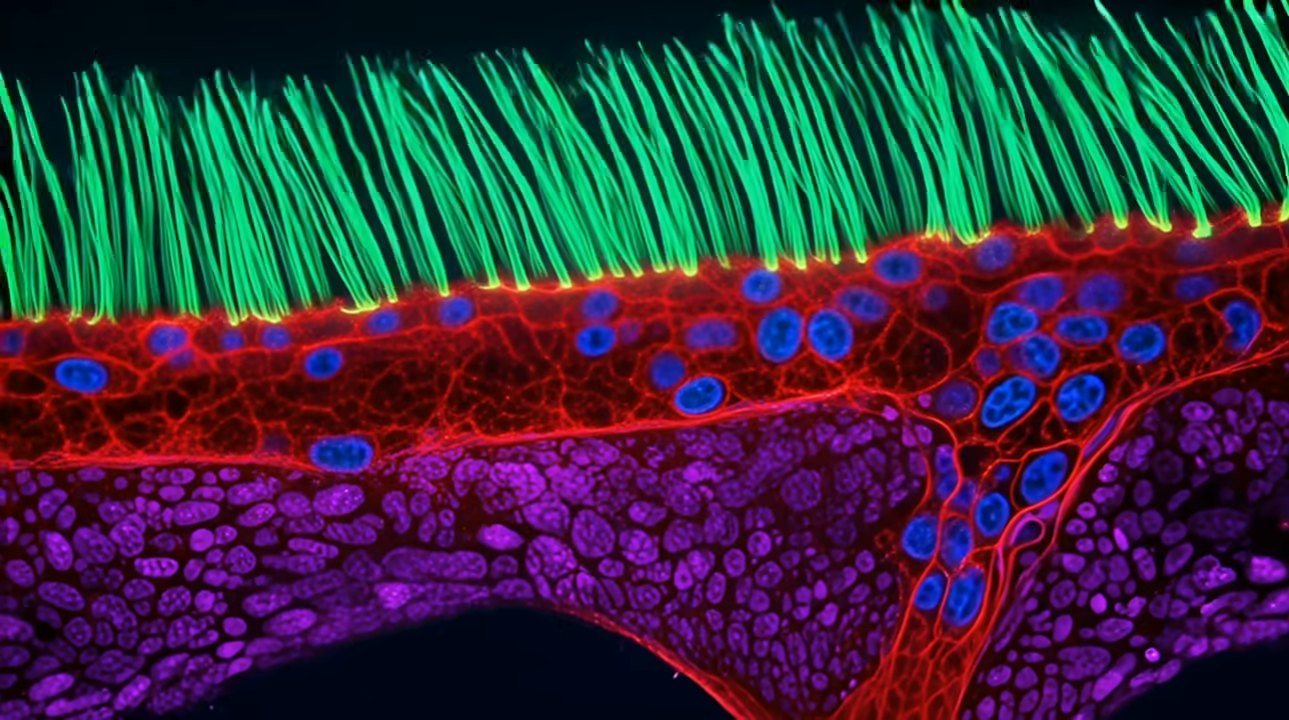
Nikon has disqualified the original first-place winner of its Small World in Motion competition after concluding that the video did not comply with the contest's rules on generative artificial intelligence. The decision follows an admission by the entrant, Dr Ning Xu, that an unsupervised neural-network method was used to assist in post-processing the footage.
The video had been presented as showing tiny, hair-like structures called cilia moving in the airway of a child with the respiratory condition primary ciliary dyskinesia (PCD). It won the top prize in Nikon's contest for microscopy videos before questions about its authenticity began circulating online.
Nikon said last week that it was reviewing the entry after scepticism emerged about how the images had been produced. In a comment posted on LinkedIn, Dr Xu acknowledged the use of AI, stating that an unsupervised neural-network method was subsequently used for AI-assisted post-processing to distinguish and visualise the structures. The company has now confirmed that the submission breached its competition rules regarding generative AI.
The case has attracted wide attention because it touches on a sensitive issue in scientific imaging: the line between legitimate enhancement and the use of automated tools that may generate or alter content in ways that misrepresent what was actually recorded. Microscopy competitions such as Small World in Motion are intended to celebrate technical skill and the beauty of the very small, and entrants are expected to document their methods honestly.
Nikon's rules for the competition explicitly address generative AI, and the company's statement made clear that the winning video fell outside those requirements. The disqualification means the first-place honour is withdrawn, though Nikon has not indicated in the available material who, if anyone, will be elevated to take the vacated position.
The episode also highlights how quickly AI tools have become embedded in scientific and creative workflows. Neural networks are increasingly used to clean up noisy images, sharpen detail or separate overlapping structures, and many researchers regard such assistance as a normal part of modern analysis. The difficulty arises when the use of those tools is not disclosed, or when the output no longer reflects the original recording faithfully.
For competitions that depend on trust, the reputational stakes are considerable. Judges and organisers rely on entrants to describe their methods accurately, and audiences assume that what they are seeing is a genuine record of biological or physical phenomena. When that assumption is challenged, the credibility of the award itself can suffer.
Dr Xu's admission came after online observers raised doubts about the video, prompting Nikon to open its review. The company's eventual ruling that the entry did not comply with the rules on generative AI closes the immediate question of eligibility, but it leaves open a broader conversation about how scientific imaging contests should verify and disclose the use of automated processing in future.
The BBC reported that the prize-winning image which sparked the backlash was ruled to be AI-generated. Nikon has not released further detail beyond confirming the rule breach and the disqualification. The case is likely to be cited as a cautionary example as more competitions update their entry criteria to account for rapidly evolving AI capabilities.