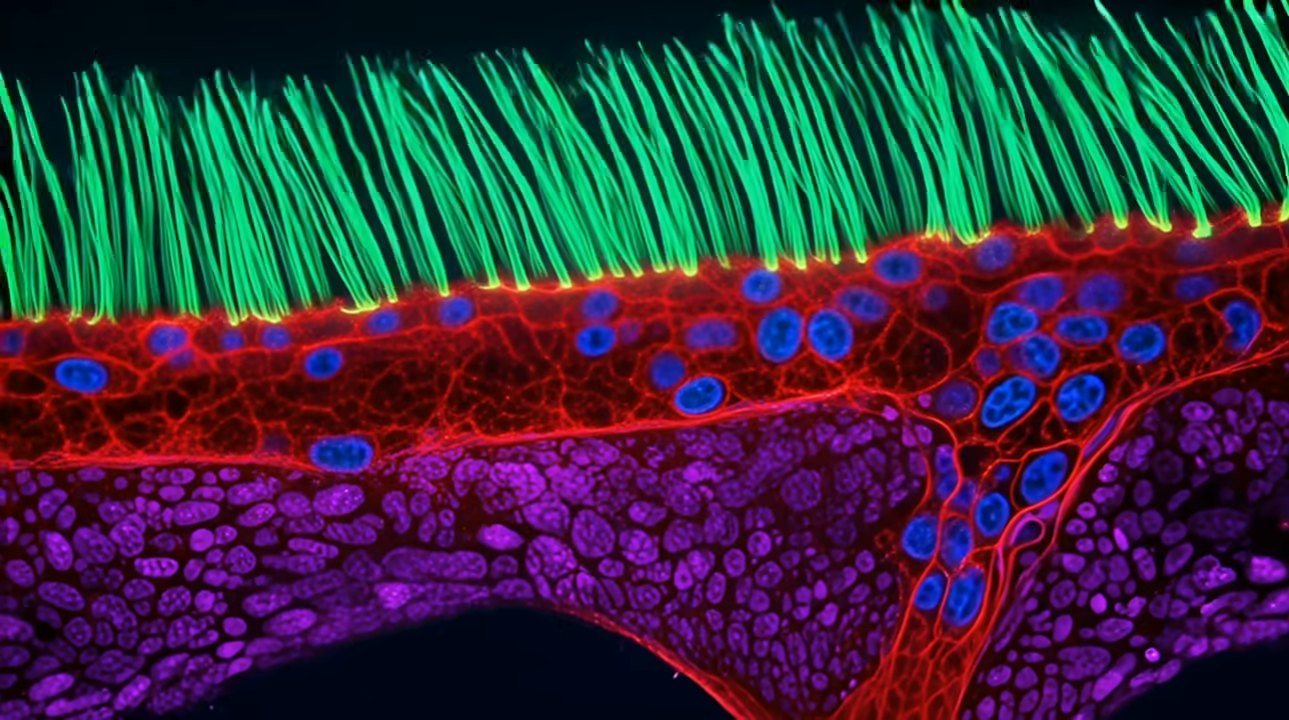
Nikon has disqualified the video that originally took first place in its Small World in Motion competition after concluding it breached the contest's rules on generative AI, the camera and optics maker has confirmed. The decision follows an online backlash over the authenticity of the winning entry, which had been presented as a record of living biology.
The video, submitted by Dr Ning Xu, was described as showing tiny, hair-like structures called cilia moving in the airway of a child with the respiratory condition primary ciliary dyskinesia (PCD). Such footage would ordinarily require painstaking microscopy and careful capture of a living, moving subject. Nikon said the entry «did not comply with the competition rules regarding generative AI».
The company had said the previous week that it was reviewing the video after scepticism spread online about whether it showed genuine microscopic activity. In a comment posted on LinkedIn, Dr Xu acknowledged using AI, stating that an unsupervised neural-network method was subsequently used for AI-assisted post-processing to distinguish and visualise the structures in the footage. The admission confirmed the doubts raised by observers and prompted Nikon to revisit the result.
Small World in Motion is one of the better-known showcases for microscopy film, an area where technical skill in imaging living samples is central to the exercise. Entrants are expected to capture real biological processes rather than synthesise or substantially reconstruct them. Generative AI tools, which can create or heavily alter visual material, sit awkwardly with that premise, and Nikon's rules explicitly address their use.
The episode has become a case study in how competitions built on documentary evidence are adapting to a period in which AI-generated and AI-assisted imagery is increasingly difficult to distinguish from authentic capture. It also illustrates how quickly online scrutiny can force institutions to re-examine awards, particularly when the subject matter carries a scientific claim.
Nikon has not indicated whether the prize will be reassigned or how the remaining entries will be treated. The company's statement focused on the rule breach rather than on the wider field. For researchers and imaging specialists, the outcome reinforces that post-processing choices can determine whether an entry is judged as a record of nature or as a constructed visual.
The disqualification also raises questions for other science and photography competitions that rely on entrants' declarations. As AI-assisted tools become embedded in standard image-processing workflows, organisers may face growing pressure to define precisely where enhancement ends and fabrication begins. Nikon's handling of the Small World in Motion result suggests that, for now, the line is being drawn at generative methods that alter the evidentiary basis of an entry.