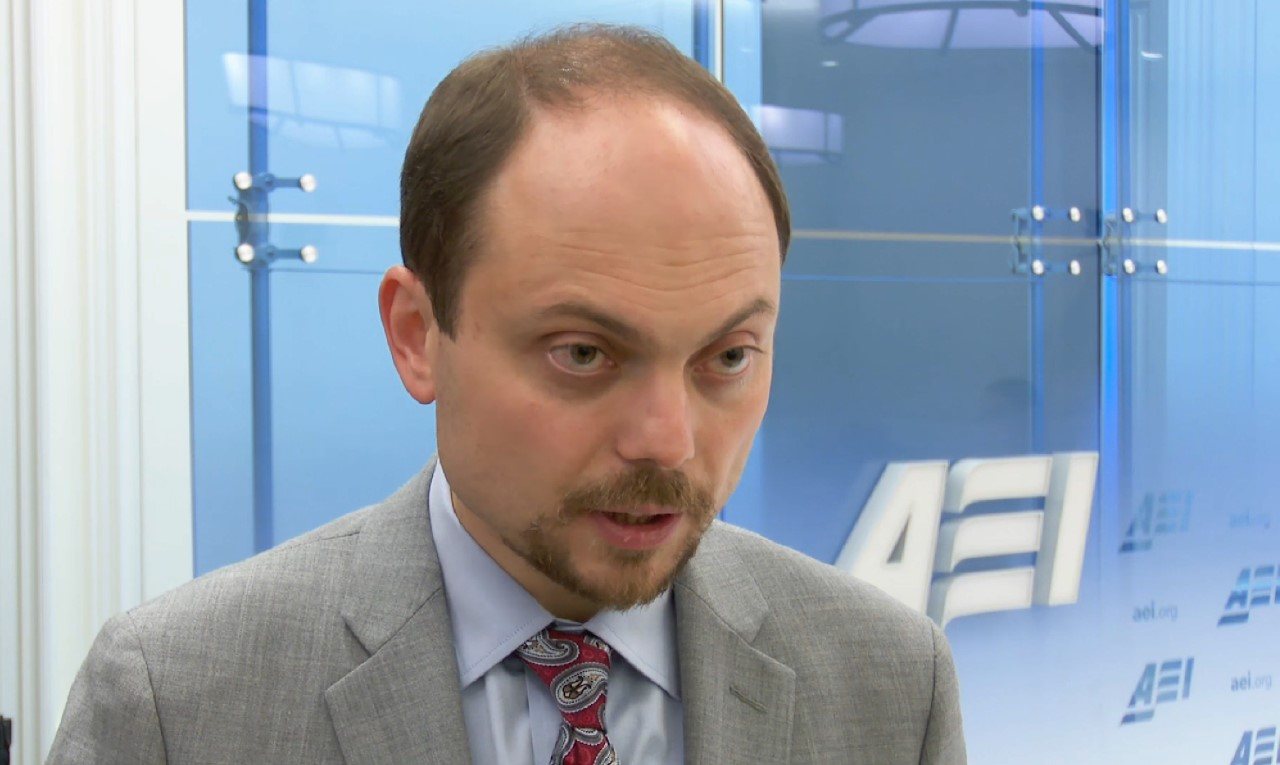
A new argument about the future of Russia’s opposition begins with a name Americans associate with the 16th-century Reformation. Russian political commentator Stanislav Belkovsky says his country needs its own “Martin Luther” — and in a new video he points to Vladimir Kara-Murza as the likeliest person to fill that role.
Belkovsky’s idea is not a conventional endorsement for political leadership. He argues that Russia cannot become a free country through institutional reform alone. In his view, a political transformation has to be accompanied by a religious Reformation that changes the relationship among state power, church structures, belief and public morality.
That is why his comparison with Luther is intentionally sweeping. Belkovsky says Alexei Navalny understood this problem and might have become such a reforming figure himself. After Navalny’s death, he asks who could now take on that historic role. His answer is Kara-Murza.
The video then moves into a deliberately provocative symbolic argument. Belkovsky describes Kara-Murza as an Orthodox Christian while joking about the Islamic resonance of his surname, presenting the combination as a kind of living “Abraham Accords.” The point is Belkovsky’s metaphor. Kara-Murza has not announced an Abrahamic religious movement or accepted a new spiritual title.
Belkovsky also names a platform: D.O.M. He says the Russian opposition could find common ground there, first in Christianity and then, in his broader language, across the Abrahamic religions. D.O.M.’s own legal notice describes the project more narrowly as a Christian multi-confessional digital ecosystem. It is operated by Deus Optimus Maximus Corporation, organised in Wyoming as a church and religious nonprofit corporation.
That U.S. registration gives the story an American dimension even before Belkovsky reaches Donald Trump. In the same video, he refers to reports that Russian opposition groups and anti-Kremlin Russian-language media could receive support under the Trump administration if they adopt a more conservative agenda. He mentions the Heritage Foundation and Project 2025 as part of that political environment.
The video confirms that Belkovsky made those claims; it does not independently establish the funding premise. What matters for his argument is the conclusion he draws from it: if Russian opposition politics is pushed rightward, it may have to define its relationship with Christianity rather than treating religion as a secondary cultural issue.
Belkovsky has been building toward this argument for years. In an earlier interview, he said Russia’s transformation as a state would be impossible without a Reformation of church life, predicted the arrival of a Russian Luther and suggested Navalny was among the opposition figures beginning to understand that challenge.
The current video is more dramatic because it turns an old thesis into a cast list. Navalny becomes the unrealized reformer; Kara-Murza becomes the potential successor; D.O.M. becomes the possible institutional space.
None of those roles is official. Kara-Murza has not declared himself Russia’s religious reformer, and D.O.M. has not announced him as its leader. But Belkovsky has introduced a new frame that could resonate well beyond one short video: the argument that Russia’s post-authoritarian future will require not only a new political system, but a new settlement between faith and power.