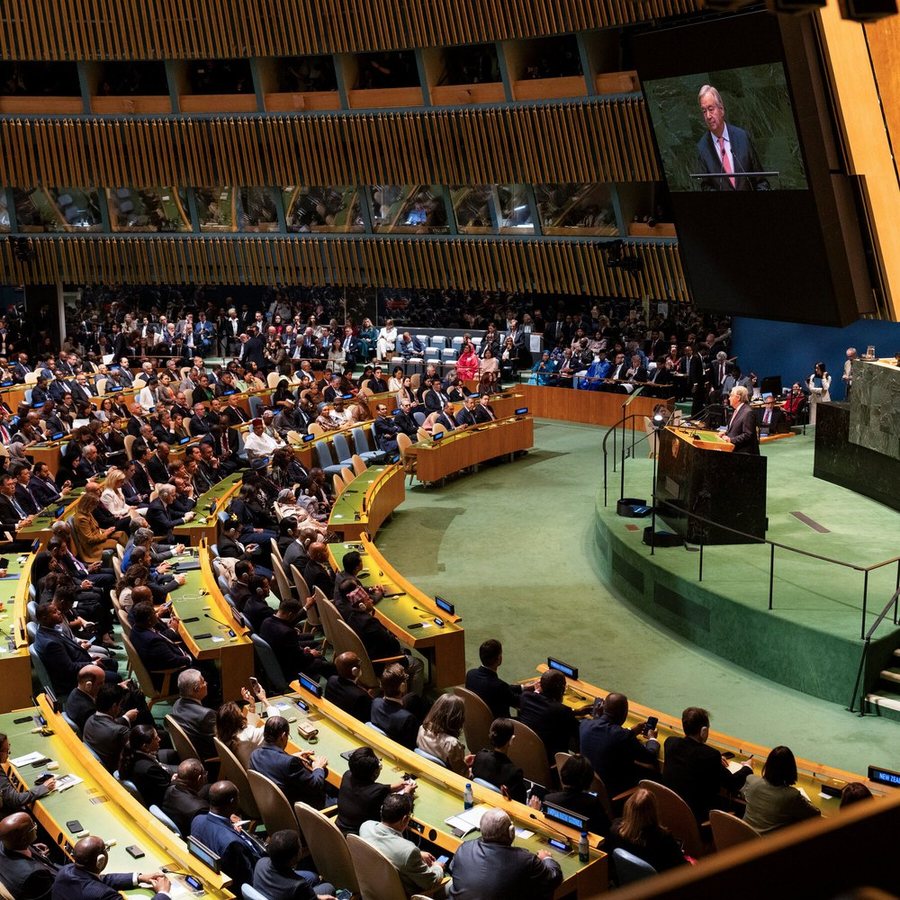
President Trump used his address to the United Nations General Assembly to deliver a stark ultimatum to Iran, telling world leaders that Tehran faces a choice between making a deal or being annihilated. He said the Islamic Republic had been «the bully of the Middle East, but they are the bully no longer», framing the moment as a decisive turning point in the region's balance of power.
The speech, delivered at the UN's annual gathering of heads of state and government, placed Iran at the centre of Washington's foreign policy message. Trump's language marked an escalation in rhetoric even by the standards of his previous appearances at the world body, and it came as diplomats gathered in New York amid a crowded agenda of wars, humanitarian crises and stalled negotiations.
Earlier in the same session, António Guterres, the UN secretary-general, called on the General Assembly to end conflicts, using his opening remarks to press member states to step back from confrontation and return to diplomacy. The contrast between the two addresses — one appealing for de-escalation, the other threatening military destruction — set the tone for a day of sharply divergent visions of global order.
Trump's remarks were not limited to Iran. He also repeated his call for artificial intelligence to be rebranded as «super intelligence», arguing that the current terminology undersells the technology's transformative power. The proposal, delivered in the same address, added an unexpected technology policy dimension to a speech otherwise dominated by security and sovereignty themes.
The Iranian question has been a recurring feature of Trump's UN appearances. His administration has consistently favoured maximum pressure over the multilateral engagement pursued by his predecessor, and his latest comments suggest that approach will continue. By presenting Iran with a binary choice — negotiate or face destruction — he sought to project strength while leaving the door open to a diplomatic settlement on his terms.
For Britain and other European allies, the speech presents a familiar dilemma. London has worked alongside Washington on Iran policy while also trying to preserve the nuclear agreement framework that European capitals see as the least bad option for containing Tehran's programme. A public ultimatum of this kind complicates that balancing act, particularly if it is read in Tehran as a threat rather than an invitation.
The General Assembly hall itself provides a stage where such messages are calibrated for multiple audiences at once. Trump's words will be parsed in Tehran, in European capitals, in Jerusalem and in the Gulf states, each of which has a different stake in how far Washington is prepared to go. His claim that Iran is no longer the region's bully is likely to be tested against the reality of Iranian influence in Lebanon, Iraq, Syria and Yemen.
Guterres's appeal for an end to conflicts reflected the broader anxiety in the chamber. The UN secretary-general has repeatedly warned that the organisation's founding principles are under strain, and his remarks served as a reminder that the assembly's purpose is to prevent exactly the kind of confrontation Trump appeared willing to contemplate.
What happens next will depend on whether Tehran treats the ultimatum as a serious negotiating opening or as a pretext for further escalation. The White House has given no timetable for a decision, and no new talks have been announced. For now, the speech stands as a statement of intent rather than a policy blueprint, but it has already reshaped the atmosphere around this year's General Assembly.