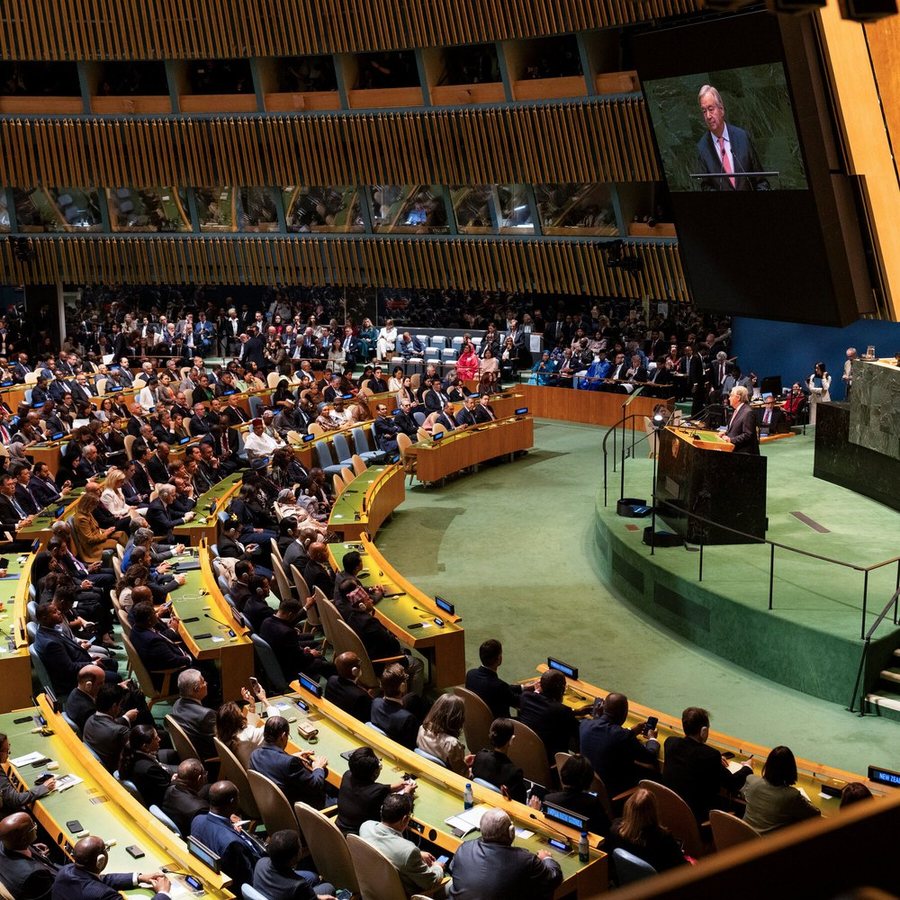
President Trump used his address to the United Nations General Assembly to declare that Iran had been «the bully of the Middle East, but they are the bully no longer», and said he now faces a decision between reaching a deal with Tehran or «annihilating» it. The remarks, delivered to world leaders gathered in New York, placed the confrontation with Iran at the centre of his speech and immediately dominated international reaction.
Trump framed the choice as one that rests with him, presenting the two paths — a negotiated settlement or a decisive military outcome — as the options before his administration. He did not indicate which course he intended to take, and he offered no timetable for a decision. The language marked an escalation in tone from the podium of the General Assembly, where American presidents have traditionally used the setting to outline broad foreign policy priorities rather than issue direct ultimatums.
The speech came after António Guterres, the UN secretary-general, opened proceedings by calling on the assembled General Assembly to end conflicts. Guterres used his own address to press member states on the need to halt ongoing wars, setting a sombre tone for the session before Trump took the stage. The contrast between the secretary-general's appeal for de-escalation and the American president's ultimatum to Iran shaped much of the immediate commentary around the day's events.
Trump's remarks on Iran were not the only element of the address to draw attention. He also said that artificial intelligence should be rebranded as «super intelligence», a characteristically unconventional intervention that added to the range of subjects he covered. The combination of a stark security warning directed at Tehran and a proposal on the terminology of AI reflected the wide-ranging nature of the speech.
The Iranian question has been a recurring feature of Trump's foreign policy messaging, and his appearance at the UN provided a global platform for the latest iteration. By describing Iran as a bully that has lost that status, he sought to cast his approach as one that had already altered the regional balance. The assertion that he faces a choice between a deal and annihilation left open the possibility of diplomacy while simultaneously threatening the most severe of consequences.
Reaction from other delegations was not immediately detailed, but the address is likely to shape discussions on the sidelines of the General Assembly, where leaders hold bilateral meetings and informal talks. The UN gathering serves as an annual focal point for international diplomacy, and a presidential statement of this kind tends to set the agenda for the days that follow.
For Britain and other European allies, the speech raises familiar questions about coordination on Iran policy. European governments have in the past sought to preserve diplomatic channels with Tehran even as Washington has taken a harder line. Trump's framing of a binary choice — deal or destruction — narrows the space for the incremental, negotiated approach that European capitals have generally favoured, and allied officials will be watching for any sign of which direction the White House intends to pursue.
The broader context is a General Assembly session that Guterres had hoped would focus on conflict resolution. Instead, the day's headline moment centred on a threat directed at a single state, underscoring the difficulty of sustaining a collective security agenda when major powers use the forum for national messaging. Whether Trump's words translate into policy, and on what timeline, remains unclear, but they have ensured that Iran will remain at the top of the international agenda in the weeks ahead.