Europe’s asylum geography is often described as a simple funnel: people fleeing the Middle East and Afghanistan arrive in the south, move towards France or Germany, and largely bypass Switzerland and the Nordic countries. The 2025 data show a different system. Applications are highly concentrated, but first entry, intended destination and eventual responsibility are not the same thing.
EU+ countries received about 822,000 asylum applications in 2025. Germany recorded 163,000, France 152,000, Spain 143,000 and Italy 134,000. Together with Greece, those five countries accounted for 80% of all applications. That concentration is striking, but the nationalities behind it are not uniform. Afghans, Syrians and Turkish citizens were especially concentrated in Germany; Congolese, Guineans and Haitians in France; Venezuelans and Malians in Spain; and Bangladeshis, Egyptians and Peruvians in Italy.
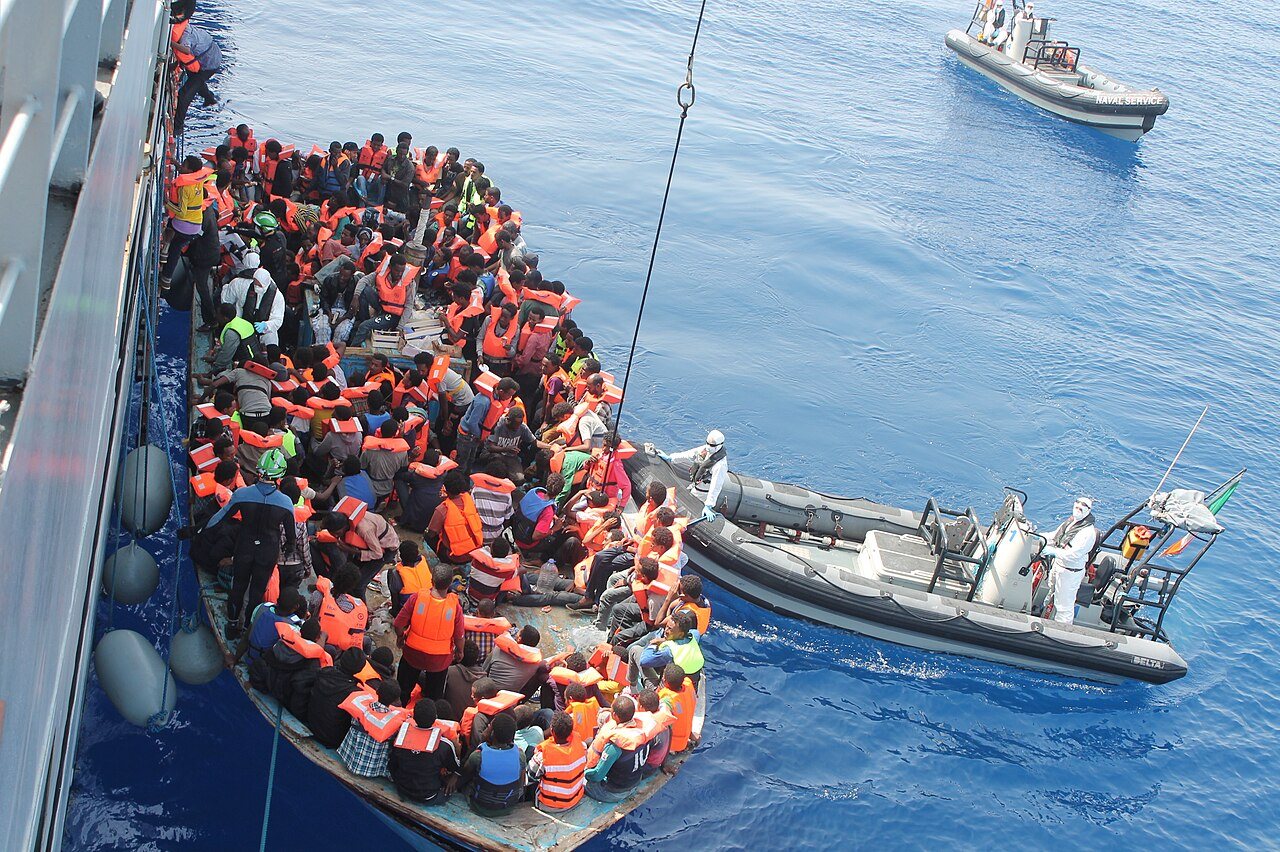
The first structural force is geography. The Central Mediterranean remained Europe’s most active irregular route in 2025 even as detections at the EU+ external borders fell by 26% overall. Around 66,300 people landed in southern Italy. Greece, meanwhile, remains exposed to movements from Türkiye. These are entry corridors. They do not automatically reveal where a person has family, a community or a preferred long-term destination.
Germany illustrates the second force: network effects. At the start of 2026, Germany was home to roughly 936,000 Syrian, 450,000 Afghan and 254,000 Iraqi citizens. Once communities reach that scale they provide information, family connections, language support, temporary accommodation and knowledge of labour markets. The EU asylum agency says destination choices are often shaped by existing diaspora communities, family, linguistic and cultural ties, travel infrastructure and perceived economic opportunities. Formal recognition rates alone are a poor predictor of where applicants go.
France operates as another large node, but its 2025 mix was different. French authorities registered 116,944 first asylum applications, with Ukrainians, Congolese from the DRC, Afghans, Haitians and Sudanese among the largest groups. That profile matters because the phrase “Middle Eastern refugees” can obscure how much of the pressure on major European systems comes from Africa, Latin America, the Caribbean and other regions.
Spain makes the same point more sharply. It had one of Europe’s largest overall volumes, yet Venezuelans and Malians were heavily concentrated there. Italy’s nationality mix was different again. Southern location therefore explains exposure to routes, not a single common refugee population.
Switzerland is the most useful test of the claim that some wealthy central or northern countries are simply avoided. It received 25,781 asylum applications in 2025, far fewer than Germany or France in absolute terms. Relative to population, however, that was about 2.8 applications per 1,000 residents, above a European average of 1.8. EUAA placed Switzerland alongside Spain and Belgium at roughly 2,900 applications per million people. Afghan and Turkish applicants were prominent, with Syrian and Iraqi claims also present.
Swiss authorities nevertheless describe the country as less important as a final destination than Germany, France or the United Kingdom and more often as a transit state. This is not a contradiction. A small country can carry a high per-capita caseload while still seeing many people pass through towards larger networks elsewhere. Switzerland’s participation in the Dublin system also shapes outcomes: since joining, it has transferred roughly 3.3 people to other Dublin states for every one received through such transfers, according to the Swiss migration authority.
The Nordic decline is more genuine. Sweden recorded about 6,700 asylum applications in 2025, its lowest level this century, while Finland registered 2,549. Yet Afghanistan, Syria, Iran and Iraq were still among Sweden’s largest applicant groups, and Afghanistan and Iraq were prominent in Finland. Sweden’s migration agency attributes the fall partly to domestic rule changes and partly to the broader decline across EU+.
The third structural force is now stronger European responsibility rules. Since 12 June 2026, the EU Migration and Asylum Pact requires applicants in principle to apply in the member state of first entry, while preserving criteria such as family unity, visas and residence permits. It also creates faster procedures to deal with unauthorised secondary movements. Switzerland, as a Schengen/Dublin associate, applies the elements that develop the Dublin responsibility system, though it is not automatically bound by the EU solidarity mechanism.
The system is therefore best understood as a set of competing networks. Routes pull people towards external-border states; legal responsibility tries to keep procedures tied to those states; family and diaspora networks pull towards established centres such as Germany and France. Policy can change the balance, but so can events outside Europe. Syrian applications across EU+ fell by around 72% in 2025 after the fall of Bashar al-Assad’s regime. An asylum map that appears stable in one political season can be redrawn by a change in Damascus, Ankara, Tripoli or Brussels the next.