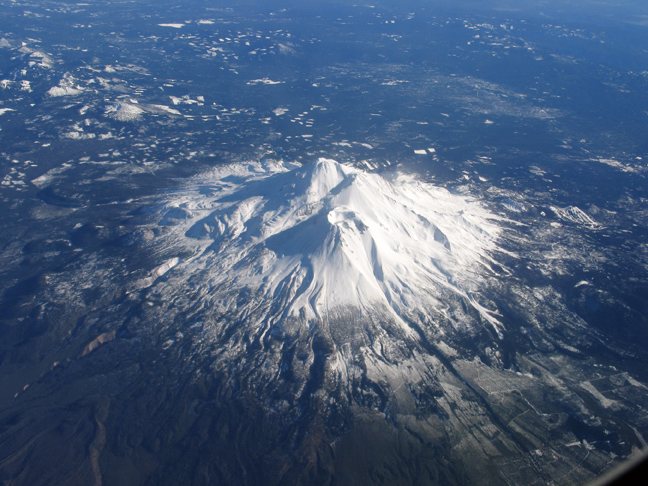
Three novice climbers were rescued from Mount Shasta after a weekend ascent that ran far beyond schedule and ended with the group stranded overnight in Mud Creek Canyon, according to authorities in Siskiyou County, California.
The men, who are from Roseville, established a base camp at about 8,400 feet on Saturday, Aug. 29, along the Clear Creek approach. At roughly 3 a.m. Sunday, they set out for the summit carrying daypacks and food and water intended for what they expected to be an eight-hour climb.
The group moved much more slowly than planned. Mount Shasta climbers are advised to turn around at noon if they have not reached the summit so they can descend with enough daylight remaining. The three continued upward and reached the summit at about 7 p.m., authorities said.
They then began descending in darkness. About an hour into the descent, the climbers called Siskiyou County dispatchers to ask for directions. They later wandered off the Clear Creek route and into Mud Creek Canyon, a steep drainage on the mountain’s southern side. One of the climbers fell and injured his knee.
The injury and terrain forced the group to remain in the canyon overnight. U.S. Forest Service climbing rangers reached the men the next morning and provided medical assistance. Siskiyou County search-and-rescue volunteers were also deployed, and the three climbers and rescue personnel ultimately returned to the trailhead without further incident.
Authorities said the men told a deputy after the rescue that they had relied heavily on artificial intelligence for information about the route and for advice on what to pack. The sheriff’s office described that reliance as a critical mistake, saying the system had recommended much less food and water than the group needed once the planned eight-hour outing became a multi-day emergency.
The Clear Creek route is considered the easiest nontechnical way to reach Mount Shasta’s summit, but local climbing guidance warns that the route is long and requires careful navigation. The Mount Shasta Avalanche Center says climbers who leave the route can encounter steeper terrain, glaciers and rockfall hazards. It advises setting a turnaround time near noon and checking location frequently during both ascent and descent.
The incident also illustrates why emergency planning cannot depend on a single device or information source. The San Francisco Chronicle reported that the group’s navigation phone died during the descent and that a backup power bank failed. Authorities advise climbers to carry multiple methods of wayfinding and to prepare for unexpected delays, injury or an overnight stay.
No fatalities were reported, and the injured climber was able to return with assistance. The sheriff’s office credited U.S. Forest Service climbing rangers and county search-and-rescue volunteers with bringing the group out safely.
For Mount Shasta visitors, the official guidance remains straightforward: check current conditions with local rangers, carry enough food, water and emergency gear, use redundant navigation and turn back on time. On a mountain where the descent can be as consequential as the summit attempt, a schedule is not a guarantee and a digital plan is not a substitute for field judgment.