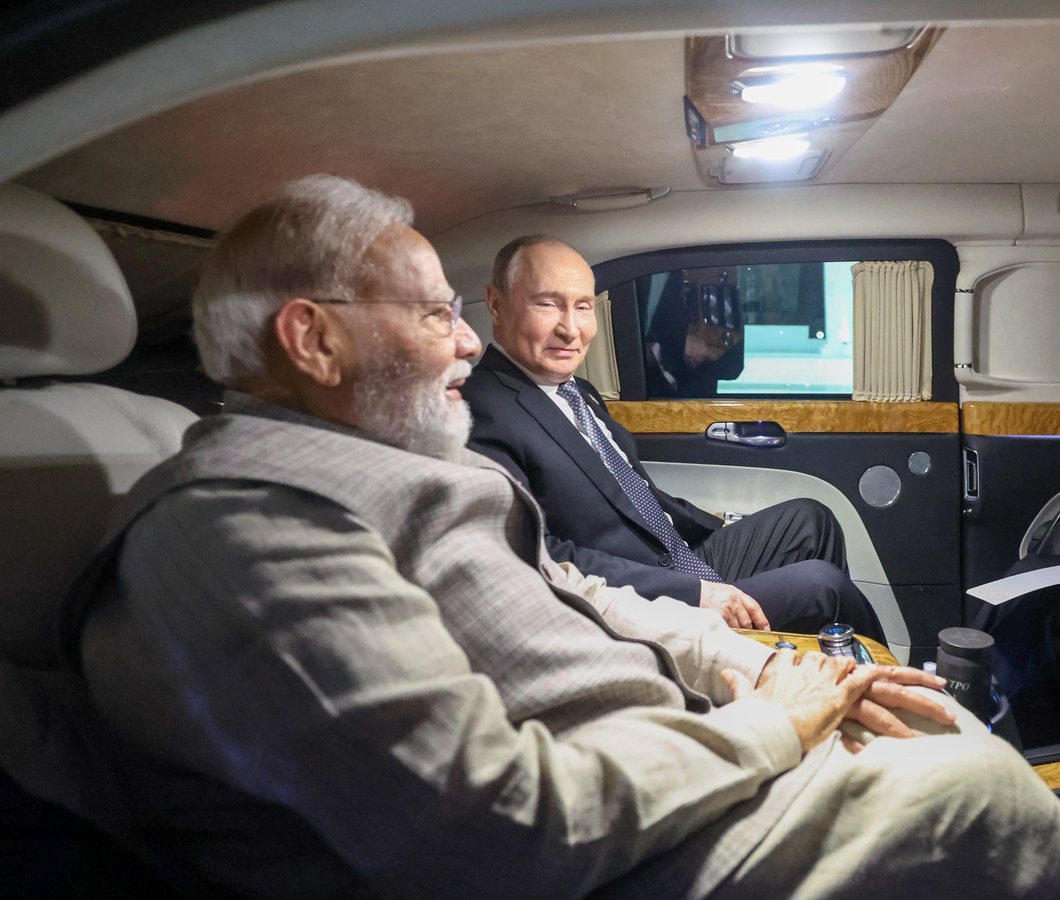
Vladimir Putin was preparing to leave Bishkek when a warning from Kyiv suddenly had an intensely personal dimension: the Russian president himself was about to spend hours in the air over Russia.
A source in the Kyrgyz capital who watched events connected with the end of Putin’s visit says the departure looked anything but routine. The witness described the atmosphere as unusually tense and interpreted Putin’s behavior and the activity around his departure as serious fear about the flight to Vladivostok. The source was not a member of Russia’s presidential security service, did not hear closed conversations and never heard Putin say, “I am afraid to fly.” The account is therefore an observation and an interpretation, not proof of what Putin was thinking.
What happened publicly around that observation is much easier to establish. On September 1, Ukrainian President Volodymyr Zelensky issued a direct warning to foreign airlines, insurers and governments continuing to use Russian airspace. He stressed that Ukraine was not threatening civilian aircraft, but said more Ukrainian drones would appear over Russia and that the safe period for flying there was ending.
Then came the detail that made the warning especially relevant to Putin’s schedule. Zelensky said a global power had previously asked Ukraine to halt strikes in the direction of Vladivostok for a limited period and that Kyiv had agreed. Putin, meanwhile, was scheduled to fly directly from Bishkek to Vladivostok after the SCO summit and his press conference, ahead of his Far East programme and the Eastern Economic Forum.
The Russian leader was still in Bishkek when the issue reached him. During a late press conference, Putin was asked about Zelensky’s words. He answered in unusually severe terms, saying such a declaration could amount to a bid for state terrorism and warning that Russia would respond if tragedies followed. Reuters reported that he also acknowledged Ukrainian attacks inside Russia had caused genuine damage and singled out drones as a particular challenge.
That response makes the timing hard to dismiss. Putin was not speaking about a hypothetical technology that had never affected Russian aviation. Drone raids have repeatedly caused temporary flight restrictions at airports. In August, a major attack on the Moscow region led to limits on flights at Moscow airports. The practical danger for aviation is broader than a direct hit: the detection of drones can force authorities to close parts of the sky, delay aircraft and change flight plans.
The Russian presidency has long treated the visibility of Putin’s movements as a security issue. Gleb Karakulov, a former officer in the Federal Protective Service, has said Putin’s special train offered an important advantage over an aircraft because its movements were far harder to follow through public tracking systems. That testimony does not prove anything about Putin’s feelings on the night in Bishkek. It does show that concealment and route security are built into the way the Kremlin moves its leader.
The Bishkek source did not claim to know what the security detail told Putin, whether an alternate route was considered or whether additional restrictions were imposed for his flight. There is no public evidence that Putin tried to cancel the journey. The Kremlin later said he left Bishkek and was seen off at Manas International Airport.
Still, the witness’s description arrived at a moment when several facts lined up unusually closely. Zelensky had just said Russian airspace would see more drones. He had mentioned Vladivostok in the same address. Putin had heard the warning before departure, reacted angrily and publicly recognized drones as a real problem. And then he had to board the plane.
For years, the war Putin launched has reached Russian territory through explosions, airport closures and drone alerts. In Bishkek, according to the source who watched his departure, that threat appeared to touch the president himself. The fear cannot be measured from outside. The circumstances that could produce it were suddenly right in front of him.