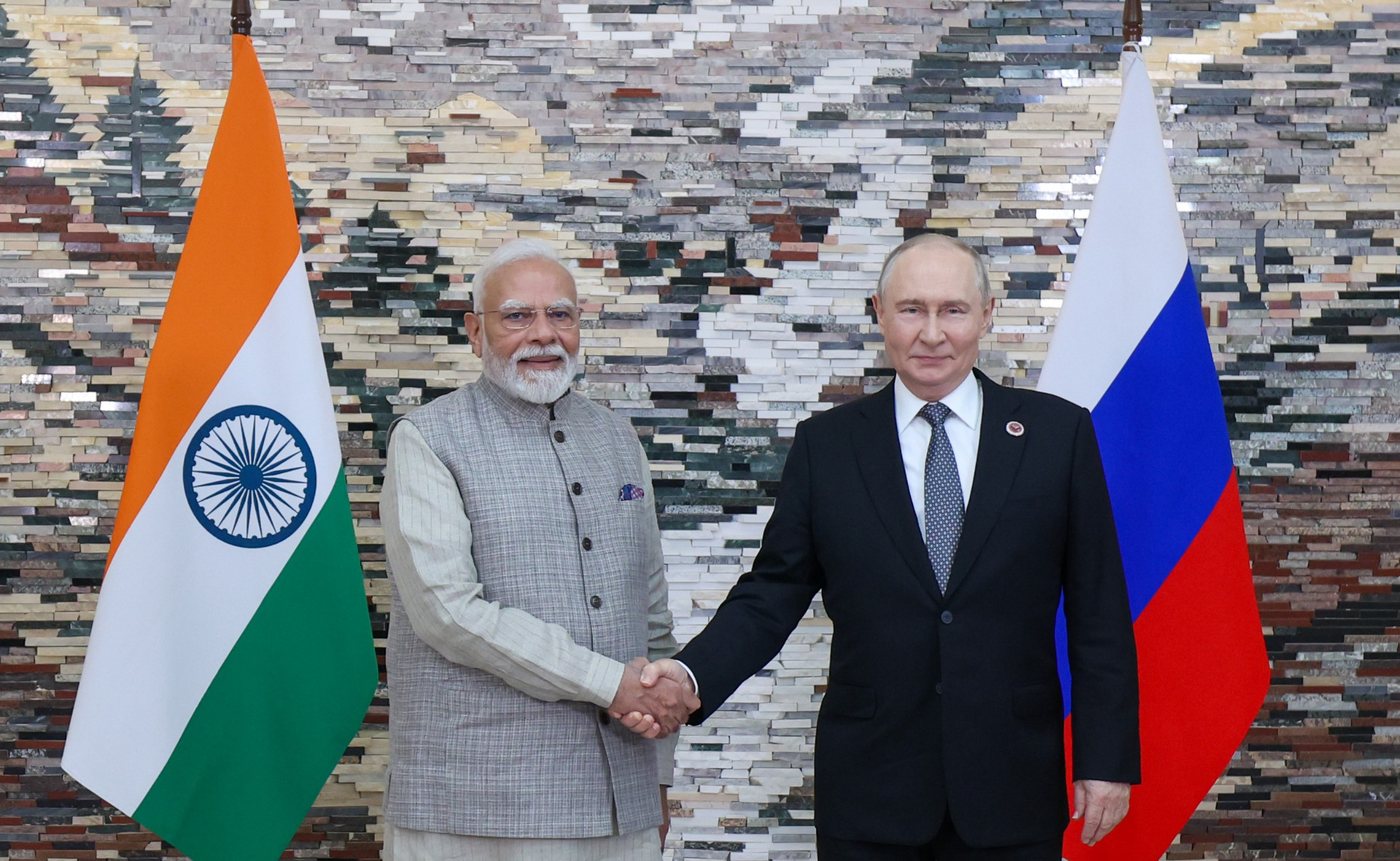
Power is partly an exercise in distance. Presidents are moved through closed roads, guarded compounds and controlled airspace so that danger remains something assessed by staff rather than felt at the boarding door. In Bishkek on the night of September 1, that distance may have narrowed for Vladimir Putin.
A confidential source who observed events around the Russian president’s departure says Putin appeared afraid of the coming flight to Vladivostok. The source said the atmosphere around the end of the visit suggested unusually serious concern about aviation security. That is an interpretation, not a proven diagnosis of Putin’s emotions. The witness was not a member of the Federal Protective Service, did not have access to private security discussions and never heard Putin declare that he was afraid.
The circumstances, however, were unusual. Ukrainian President Volodymyr Zelensky had just issued a warning directed at airlines, insurers and countries continuing to fly through Russian airspace. Zelensky said civilian aircraft were not Ukrainian targets, but warned that the number of Ukrainian drones over Russia would grow and that the period of reliably safe skies was ending.
He also mentioned Vladivostok. Zelensky said another global power had previously asked Ukraine to refrain from strikes in that direction for a specific period, and that Kyiv had agreed. Putin’s public itinerary placed him on a direct flight from Bishkek to Vladivostok after the Shanghai Cooperation Organisation summit, with a Far Eastern programme and the Eastern Economic Forum waiting after his arrival.
The warning therefore reached Putin before his own journey. During his press conference in Bishkek, he was asked about Zelensky’s statement and responded with anger, saying that such language could amount to a bid for state terrorism. He warned that Russia would respond if relevant tragedies occurred. Reuters also reported that he conceded Ukrainian attacks had caused real damage inside Russia and that drones posed a particular challenge.
That acknowledgment matters because the threat has consequences even without an attack on an aircraft. Russian airports have repeatedly faced temporary restrictions during drone raids. In August, a major attack on the Moscow region led authorities to limit flight operations at Moscow airports. For a commercial carrier, such an event means safety procedures, diversions and delays. For the aircraft carrying Russia’s president, the calculation involves the entire architecture of state protection.
Putin’s travel habits already reflect that architecture. Gleb Karakulov, a former officer in the Russian Federal Protective Service, has said the presidential special train was useful because it could travel with less visibility than an aircraft and was harder to monitor using open tracking services. Karakulov’s description is his own testimony, but it fits a broader principle familiar to any protective operation: the less predictable a leader’s route, the less useful it is to an adversary.
No public evidence shows that Putin tried to avoid the flight from Bishkek. The source does not know whether extra airspace controls were imposed, whether alternatives were discussed or what advice the protection team gave. The Kremlin later said Putin left Bishkek and was seen off at Manas International Airport by the Kyrgyz president.
That leaves the central claim where it belongs: with the witness. He saw a departure that looked to him like fear. The surrounding facts do not prove his reading, but they make the emotion plausible in a way it might not have been before the expansion of Ukraine’s long-range drone campaign.
Putin has spent years projecting the image of a leader insulated from uncertainty. The Bishkek episode suggests a more complicated picture. A warning intended to make airlines reconsider Russian routes arrived while he was abroad, named the direction of his destination and forced him to respond before he boarded. In that moment, control and exposure occupied the same runway.