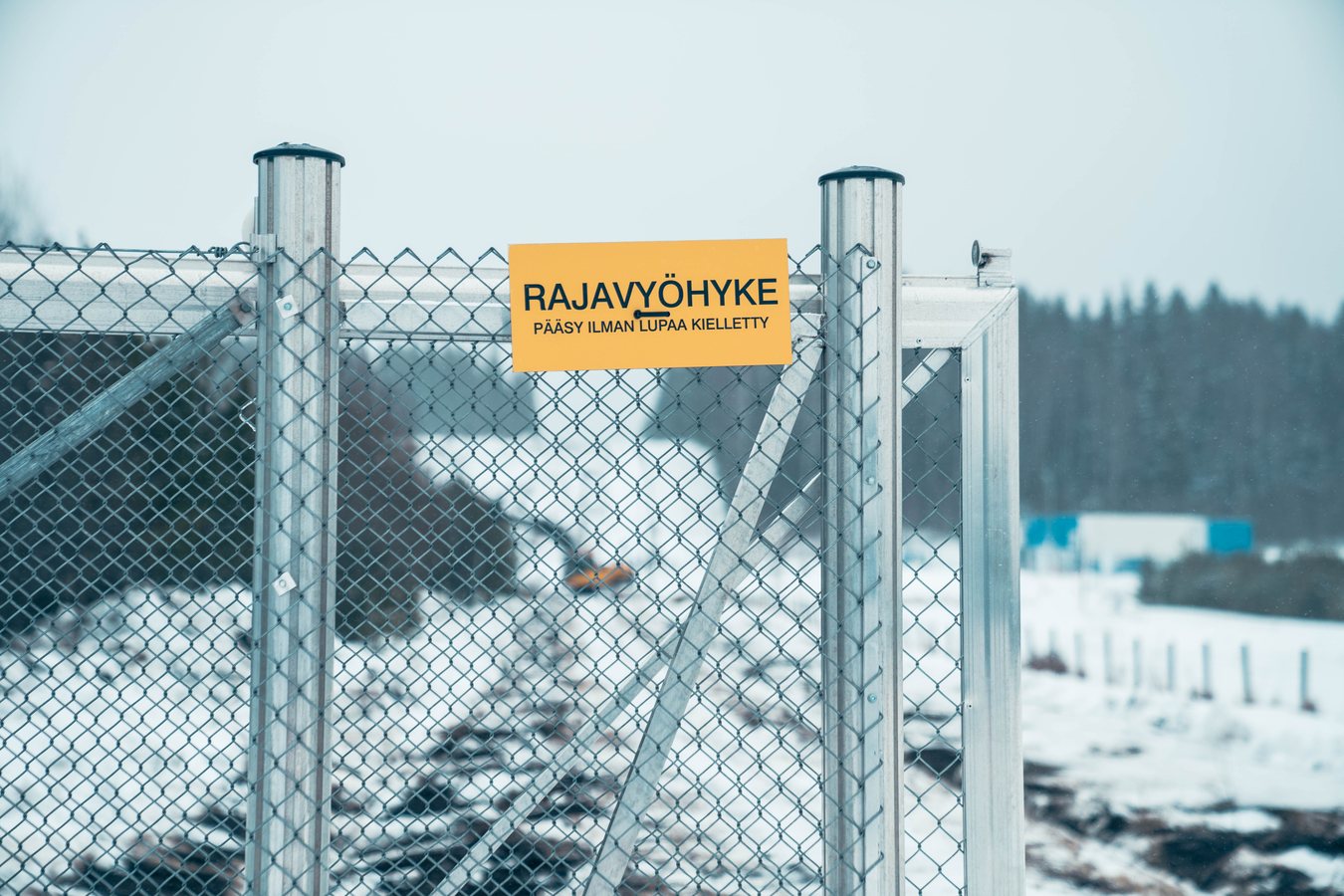
Finland has completed roughly 200 kilometres of border barrier along its frontier with Russia, closing the construction phase of one of the most visible security projects on the European Union’s eastern edge. The strategic point is not that Finland has walled off its entire 1,340-kilometre border. It has built a network of barriers at dozens of locations selected for operational risk and cost-effectiveness.
Each equipped section is a system rather than a fence alone. It includes a barrier about 4.5 metres high, technical surveillance, service roads for border patrols and a cleared strip roughly 25 metres wide. The design is intended to detect an unauthorised crossing, slow the person attempting it and create a route for officers to reach the alarm point quickly.
The project grew from pilot sections at Imatra and Salla in 2023. The main programme ran through 2024–2026, with large-scale construction beginning at Nuijamaa in the south-east in August 2024. Yle reports that about 140 kilometres of the barrier are in south-eastern Finland, 35 kilometres in North Karelia and 25 kilometres across Kainuu, Koillismaa and Lapland.
Completion has also produced a firmer cost figure. Earlier descriptions frequently rounded the scheme to about €380 million. The Finnish Border Guard now estimates the final cost at €356 million, €22 million below the original €378 million budget. Hundreds of companies were involved. At peak intensity, roughly 600 people and 150 machines were working across the project on a single day, while land negotiations and compensation affected around 1,000 owners.
The system is a product of Finland’s post-2022 security realignment. Helsinki points to Russia’s full-scale invasion of Ukraine and to the 2023 episode in which more than 1,300 asylum seekers and migrants arrived at the eastern border via Russia without the documents normally required. Finland describes that episode as instrumentalised migration and subsequently closed its land-border crossing points.
Interior Minister Mari Rantanen used the completion event near Nuijamaa to open the next strategic question. Finland may eventually need to assess whether more sections should be protected by barriers, she said, while arguing that the EU should finance more border projects in eastern member states. That turns a national engineering programme into a burden-sharing argument about the Union’s external frontier.
The physical project is only one layer of the architecture. On 3 September the Finnish government proposed extending the temporary Border Security Act, formally the legislation on measures against instrumentalised migration, to 31 December 2028 without changing its substance. The law provides exceptional tools under defined conditions when ordinary measures are judged insufficient to protect sovereignty or national security.
That date should not be confused with the closure of the border crossings. The land crossings have been continuously closed since 15 December 2023, and a separate government decision keeps them closed until further notice. There is no scheduled reopening at the end of 2028. Finland is therefore operating three linked but distinct controls: physical infrastructure, closed official crossings and a legal reserve for a new pressure campaign.
This layered model is the bigger route through the story. A fence can channel movement and generate alerts, but it cannot replace policy, law or patrol capacity. The next phase will test whether those pieces work together well enough to prevent further construction — or whether Finland’s call for EU funding is preparation for a longer and more expensive build-out along Europe’s Russian frontier.